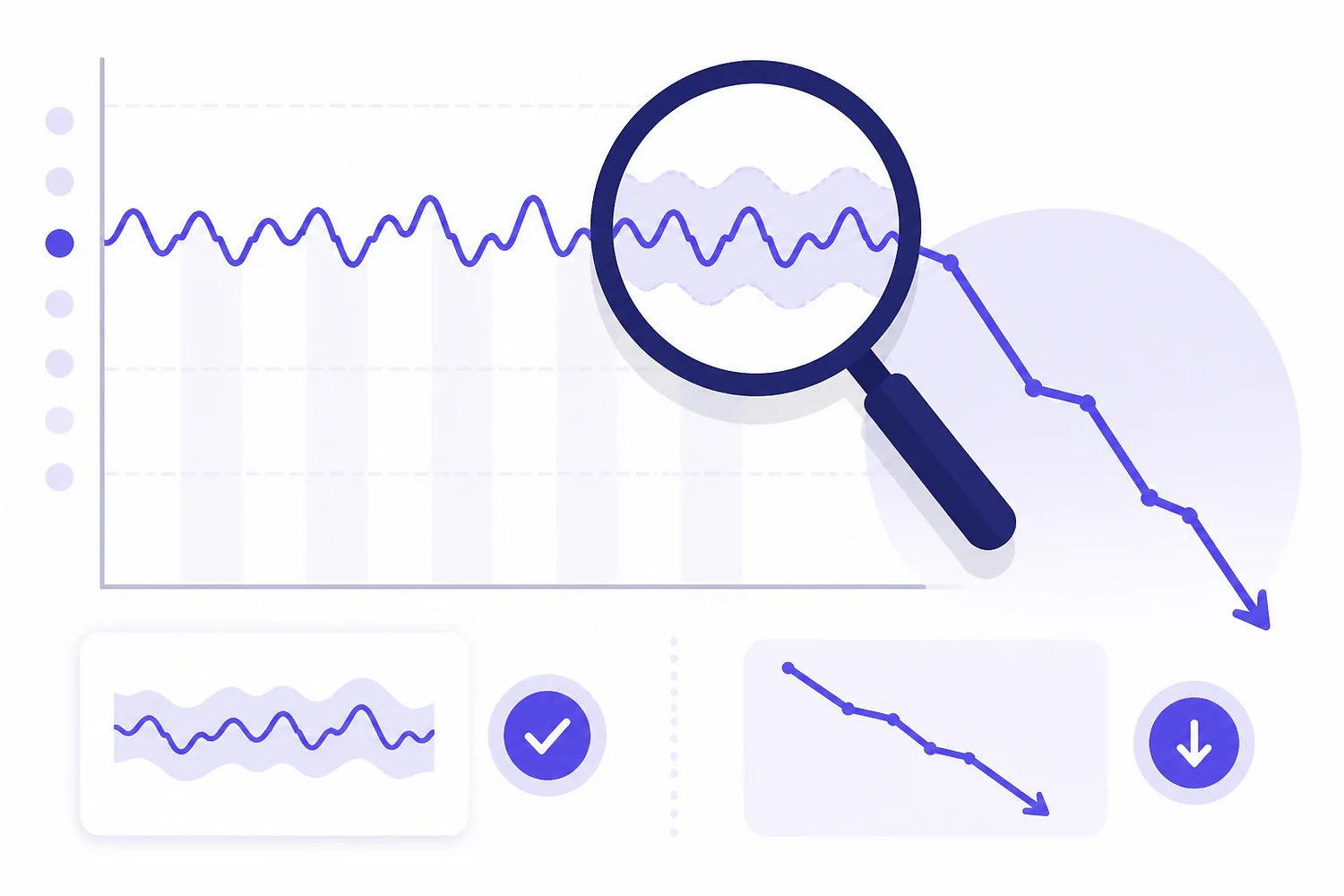
There is no scoreboard. Every search recomputes your rank.
Google doesn't store your ranking anywhere. Your position is calculated fresh for every single search, shaped by who's searching, where they're standing, what device they're holding, and whichever live experiment Google happens to be running on that query. That's why rankings fluctuate: you're sampling a moving system, not reading a fixed number off a board. Day-to-day movement of a few positions is that machinery working normally. A real problem has a different shape: the drop is bigger, it holds for weeks, and it hits many keywords at once. This page covers both, and how to tell them apart before you rewrite a page that was never broken.
Personalization
Search history, logged-in accounts, and past clicks tilt results toward what Google thinks that specific user wants. Two people, same query, different order. Your own browser is the least neutral place there is to check your rank.
Location, down to the block
Results shift by country, by city, and for anything with local intent, by street. A plumber can sit at 2 near the shop and 15 across town for the same keyword at the same minute. Neither number is wrong.
Live testing
Google ships thousands of ranking changes a year and tests far more than it ships. Some slice of queries is inside an experiment at any moment. Land in the test bucket and your rank moves for a day, then moves back.
The SERP changed shape
An AI Overview, a local pack, or a featured snippet appearing or vanishing rearranges the page around you. Your position number can hold perfectly steady while your actual placement on screen moves half a viewport down.
Desktop and mobile disagree
They're separate result sets and often rank the same page differently. If yesterday's check was on a laptop and today's was on a phone, you compared two different SERPs and called it a fluctuation.
When you looked
A rank sampled at 8am and again at 6pm can differ while an index change propagates, and different Google data centers can briefly serve different results. Checks taken at a consistent time are the only ones worth comparing.
How much ranking fluctuation is normal?
For most keywords outside the top three, daily movement of two to five positions is ordinary and means nothing on its own. The pattern is consistent: positions 1 to 3 tend to hold fairly steady because the gap between those results is usually wide, the middle of page one swings more, and page two is close to random on any given day because the scoring differences between results down there are tiny. New pages also swing harder than established ones for their first weeks while Google settles on where they belong.
A single reading matters far less than the series it belongs to. That's the entire reason rank trackers exist: a tracker re-runs your searches on a schedule from clean, location-pinned machines with no history and no login, which is how rank tracking actually works, and the line it draws is what separates a Tuesday wobble from a genuine slide. One check tells you where you stood at one moment inside a moving system. Twenty-one daily checks tell you whether you have a problem.
One rank check is a sample. Three weeks of them is an answer.
Normal noise and real drops leave different fingerprints.
Before you touch the page, score the movement against these two columns. Most scary-looking Monday morning charts match the left one.
Normal noise
Ignore it and keep working.
- ✓ Moves 2 to 5 spots, then returns within days
- ✓ One keyword or one page, not a pattern
- ✓ Clicks and impressions in Search Console barely change
- ✓ No confirmed Google update, nothing shipped on your site
- ✓ The SERP looks the same, just reshuffled
A real drop
Diagnose it this week.
- × Falls 10+ spots or off page one, and holds for 2+ weeks
- × Many keywords or a whole topic move together
- × Impressions and clicks fall with it in Search Console
- × Lines up with a confirmed update, a deploy, or lost links
- × Someone specific now holds your old spot
The four causes worth an actual investigation.
Real drops cluster into four buckets. Algorithm updates: Google confirms core updates on its Search Status Dashboard, and rollouts typically run one to two weeks. Positions can swing daily inside that window, so judge where you landed after Google marks the rollout complete, not on day three. Lost links: when a page that linked to you gets deleted, deindexed, or rebuilt without the link, the authority it passed goes with it, and your pages that leaned on it slide over the following weeks. Technical regressions: a stray noindex in a template, a robots.txt edit, a canonical pointing the wrong way, a migration that changed URLs, or a site that got dramatically slower. These produce the sharpest drops because the affected pages stop being eligible to rank at all instead of just scoring lower. Competitors: sometimes nothing broke. Someone published a more thorough page or earned links you didn't, and your slow slide is their slow climb.
When the movement passes the real-drop test, run this before changing anything:
- Check the calendar first. Look at Google's Search Status Dashboard for a confirmed update on or near the date the slide started. If a core update is mid-rollout, note it and wait for the rollout to finish before reacting.
- Segment the damage. One keyword or fifty? One page or a whole directory? A sitewide fall points at technical causes or an update. A single page points at that page's content, its links, or a new competitor.
- Open Search Console. Falling impressions mean lost visibility, not just lost clicks. Check the Pages report for anything newly excluded from the index; a coverage error dated to the drop is a smoking gun.
- Look at the SERP itself. Search the keyword in a private window. If an AI Overview, local pack, or snippet now sits above the results, your rank can be identical while your visibility is genuinely lower.
- Audit what you shipped. Deploys, plugin updates, template edits, robots.txt or canonical changes in the two weeks before the drop. Technical regressions almost always trace back to a change someone made on purpose for a different reason.
- Study who took your spot. Open the page that outranks you now. If it's plainly fresher or more complete, the fix is content work, not detective work.
AI Overviews and local results fluctuate by design.
AI Overviews are the least stable thing on the page. The same query can trigger one on Monday and none on Wednesday, and the sources cited inside it change between runs, because the answer is generated fresh rather than pulled from a fixed list. If your traffic wobbles while your classic rank holds, an Overview appearing above you is a prime suspect, which is why tracking Google AI Overviews separately from blue-link positions has become part of the job: you want a record of when one starts sitting on top of your keyword and whether you're cited inside it.
Local rankings take the location effect to its extreme. For map results, position is a function of the searcher's coordinates, so a single "rank" for a local keyword doesn't really exist; a business holds dozens of different ranks across its own city at the same time. Checking from one spot and seeing movement often just means you measured from a different spot than last time. That measurement problem is what local grid rank tracking solves: the same keyword scanned from a fixed grid of points, 3x3 up to 11x11 across a metro, so this week's map compares cleanly against last week's.
Set a machine to watch, so you only react to real moves.
Everything above depends on data you can't gather by hand: daily positions taken at a consistent time from a clean machine, a log of which SERP features fired each day, and enough history to see whether a move held. Hypado records all of it in one workspace: daily desktop, mobile, and local rankings with SERP features and AI Overviews logged per keyword, next to the site audit and backlink data you'll reach for the moment a drop turns out to be real. The question "did I fall, or did the page change shape above me" gets answered from the same chart, and a confirmed problem sits one tab away from its likely cause.
The free plan tracks 50 keywords with weekly checks at $0, no credit card. Starter at $49/mo moves you to 500 keywords at whatever frequency you want and adds MCP access, so you can plug Hypado into the ChatGPT or Claude account you already pay for and ask "which keywords fell more than five spots this month and stayed down" against your actual data instead of eyeballing charts. Two honest caveats: Hypado is a younger platform than Semrush or Ahrefs, and if all you want is a standalone rank tracker, focused tools like AccuRanker and Nightwatch do that single job well. The argument for Hypado is proximity: the trend line, the SERP-feature log, the audit, and the links live in one place, so diagnosis doesn't mean four tools and a spreadsheet.
Ranking fluctuation, the short answers.
How much ranking fluctuation is normal?
Two to five positions of daily movement is normal for most keywords outside the top three, and swings get wilder the further down you sit; page two is close to random day to day. Movement becomes a signal when it's larger, sustained for two weeks or more, and shared across many keywords at once.
Why does my rank tracker show a different position than my browser?
Because they're running different searches. Your browser carries your history, your account, and your exact location; a tracker checks from a clean, logged-out machine pinned to a set location at a set time. Neither is lying. The tracker's number is the comparable one, because it's measured the same way every day.
Why did my rankings drop suddenly overnight?
Check four things in order: a confirmed Google update on the Search Status Dashboard, an indexing or coverage error in Search Console, a change someone shipped to your site in the prior two weeks, and the SERP itself, since a new AI Overview or local pack can push you down the page without changing your position number. Sharp overnight sitewide drops are most often technical.
How long do rankings fluctuate after a Google core update?
Core update rollouts typically take one to two weeks, and positions can swing daily while one is in progress. Judge your landing spot only after Google marks the rollout complete. Reacting mid-rollout means chasing numbers that haven't finished moving.
Should I check my rankings every day?
Let a tracker check daily; you should read the trend weekly. Daily manual checking invites reacting to noise, and reacting to noise, rewriting pages that were fine, is how stable rankings get broken. Set alerts for genuine moves and spend the reclaimed time on work that changes the trend.
Watch the trend line, not the Tuesday wobble.
Track 50 keywords free with weekly checks, no credit card. Daily tracking, SERP features, and AI Overviews when you're ready.