A machine re-runs your searches, so you can stop guessing.
A rank tracker doesn't watch Google over your shoulder. It sends your keywords to the search engine on a fixed schedule from clean, location-set machines with no login and no search history, reads back where your URL landed, and writes that position to a database with a timestamp. Do that every day for a keyword and you get a line on a chart instead of a hunch. That line is the only honest feedback loop SEO has: it tells you whether the page you rewrote, the links you earned, or the fix you shipped actually moved anything. Everything else in this guide, the features, the frequency, the reasons the number disagrees with what you see in your own browser, hangs off that one mechanism.
Your absolute position
The core number: are you at 4, at 11, at 38 for this exact query. Tracked over time it becomes a trend, and the trend is what matters. A single day's reading is noise; three weeks of a keyword sliding from 6 to 14 is a signal you can act on before the traffic drops with it.
SERP features, not just blue links
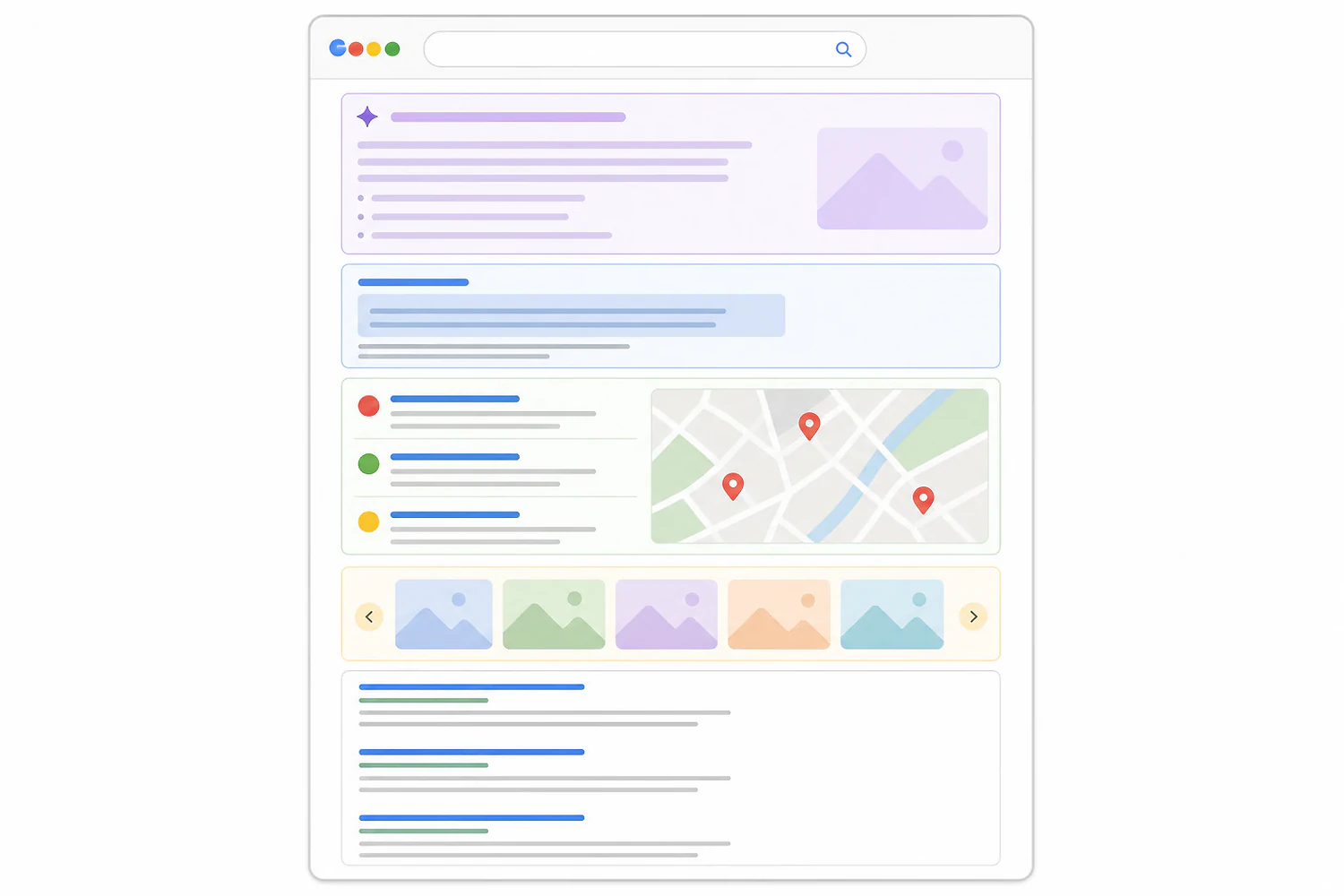
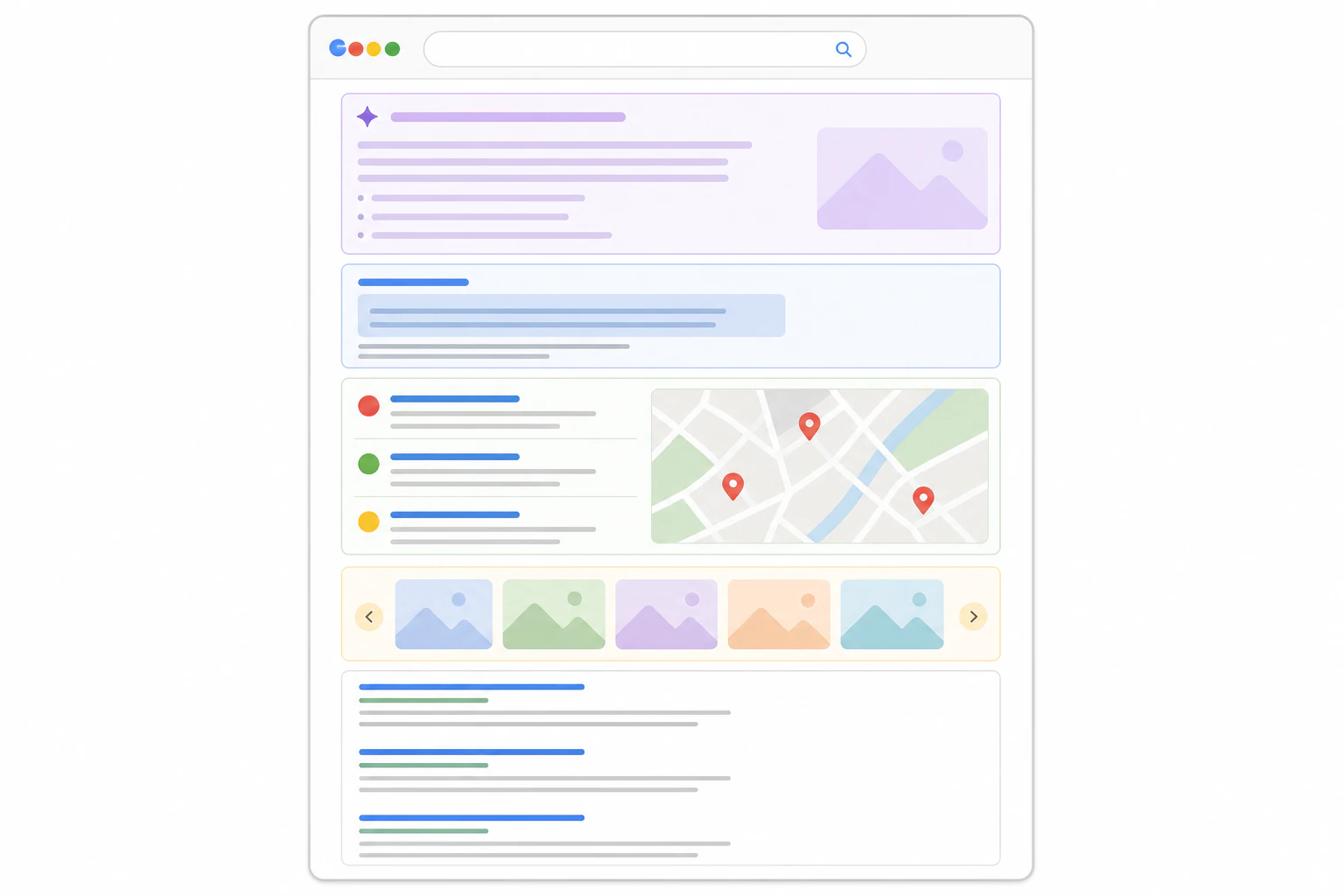
Position 3 means little if a featured snippet, a local pack, an image carousel, and an AI Overview sit above you and push the real first result halfway down the page. A tracker worth using records which features fired for each keyword and whether you're the one inside them, because that's what decides the click.
Device and location
Desktop and mobile are separate SERPs and often rank you differently, so they get tracked separately. Location matters even more: the same keyword returns a different order in Denver than in Dallas. A tracker pins each check to a device and a place so the number means something specific instead of an average of everywhere.
Where competitors sit
Your position in isolation tells you half the story. Tracking two or three competitors on the same keywords shows whether you slipped because Google changed something or because a rival simply out-published you. Roll it up across every keyword and you get share of voice: your slice of the total visibility in your market.
The one metric you can tie back to a decision.
SEO is slow and mostly invisible while it's happening. You publish, you fix, you build links, and for weeks nothing visibly changes. Without rank data you're left arguing from vibes about whether any of it worked. With it, you can line up the day you shipped a change against the line on the chart and see the response, or the lack of one. That's the entire value: it closes the loop between action and result so the next decision is informed instead of superstitious.
It also catches problems while they're still cheap. A ten-position drop on a money keyword spotted in week one is an afternoon's investigation. The same drop found in week eight, after the traffic and the revenue have already gone with it, is a salvage job. Rank tracking is the smoke alarm, not the fire report. Ranking isn't the goal, traffic and conversions are, but rank is the leading indicator that moves first, before the analytics catch up.
Watch the trend, not the daily number. One reading is weather; a month of readings is climate.
Why the tool and your own browser never quite agree.
Everyone hits this within a week: the tracker says 8, you search the term yourself and see 4, and you assume the tool is broken. It usually isn't. Here's what's actually different between the two.
- Your results are personalized, the tracker's aren't. Logged in, Google tunes what you see to your history, your past clicks, and your location. A page you visit often floats up several spots for you specifically. Trackers query from neutral, logged-out sessions on purpose, to strip that bias out, so what they report is closer to what a stranger sees than what you see.
- You're standing somewhere; the tracker chose a place. Your browser uses your real location. The tracker uses whatever city or country you configured. If those differ, the rankings differ, and that's not an error, it's the whole point of setting a location.
- The clock rarely lines up. A tracker pulls positions on its own schedule, maybe hours or a day before you check by hand. Rankings drift in between, especially past the top few results, so a small gap is normal rather than a bug.
- Page two is genuinely unstable. The top five are relatively steady; positions from ten to twenty can swing five spots between updates on their own. If your keyword lives down there, expect the number to jitter no matter how good the tool is.
- Search Console is the one source from inside Google. Every third-party tracker reverse-engineers rankings by reading the SERP from outside. Google Search Console reports average position from Google's own logs of real users, so it's the ground-truth cross-check when a tracked number looks off. It lags and it averages, but it isn't guessing.
How often to actually check, and how much to track.
Daily is the default for most active programs, because it's what lets you catch an algorithm update, a competitor's move, or a botched deploy within a day instead of a month. But daily doesn't mean staring at the dashboard every morning. Set alerts for meaningful moves and let the routine reading be weekly. Weekly is genuinely enough for a stable site in a slow niche; monthly is a long-term-trend view, too coarse to act on but fine for a quarterly report. Push to real-time-ish only around the moments that warrant it: a launch, a migration, a redesign, or a sudden unexplained drop.
On how many keywords: track the terms tied to money and to intent, not every phrase you technically appear for. A tight set of high-value head terms, the money queries that convert, and a layer of long-tail variants beats a bloated list of a thousand keywords nobody reviews. More keywords isn't more insight, it's more to babysit and, on most tools, more to pay for. Watch for cannibalization too, two of your own pages trading places on the same query, which a good tracker surfaces by showing you which URL is ranking.
Rank tracking got harder because the SERP did.
The classic list of ten organic results is now a minority of the page. Two shifts in particular have made a plain position number less complete than it used to be, and both belong in modern tracking.
The first is local. For anything with a physical or service-area component, Google shows a map pack, and your place in it depends entirely on where the searcher is standing. One blended "average position" hides the truth completely: you can be number one on your own block and invisible three miles away, and an average of the two reads as a comfortable, meaningless middle. That's why local visibility is tracked on a geographic grid of points around a location rather than a single check. We break down exactly how that works, and why an average rank misleads, in local grid rank tracking explained.
The second is AI. Google's AI Overviews now sit above the organic results on a large share of queries, and assistants like ChatGPT, Perplexity, and Gemini answer questions without anyone clicking a blue link at all. Your classic rank can hold steady while an AI answer quietly eats the click above it. Tracking whether those answers cite you, and how often, is a different measurement from position tracking but increasingly the same job. If AI Overviews are showing up for your terms, start with tracking Google AI Overviews to see whether you're being cited or bypassed.
Three trackers usually bought separately, in one workspace.
Position, local grid, and AI-answer visibility are three different measurements, and the standard answer is three different subscriptions plus a fourth tool to turn the data into a plan. Hypado's argument is that they belong together.
The honest reason they're usually separate is that the specialists are good. Semrush has the widest keyword database and the most mature enterprise tooling. Ahrefs has the deepest historical backlink index. AccuRanker and Nightwatch are fast, focused daily rank trackers. Local Falcon owns the granular geo-grid category at extreme grid sizes, and BrightLocal is a local-SEO institution. If you need the single deepest tool in exactly one of those lanes, buy it. None of that is in dispute.
What Hypado does differently is fold Google rank tracking (daily, desktop and mobile, with SERP features and AI Overviews and share of voice), the local map grid, and AI-answer visibility across ChatGPT, Claude, Gemini, Perplexity, and Google AI Overviews into one place, alongside keyword research, backlinks, audits, and competitor analysis. And it connects to the AI you already pay for: you add Hypado as a connector inside your own ChatGPT or Claude account, no developer API keys, no AI markup on top. You ask plain-English questions against your real ranking data and the assistant drafts the fix as a tracked plan your team can assign and check off. That last step is the one most trackers leave to you.
Point tools
Deepest in one lane each.
- ✓ Best-in-class depth: Semrush's keyword data, Ahrefs' backlink index, Local Falcon's giant grids
- ✓ Mature, battle-tested, long track records
- × Three or four subscriptions and three or four dashboards to reconcile
- × AI features, where they exist, usually resell the vendor's own model at a markup
Hypado
Rank, local, and AI visibility in one workspace.
- ✓ Google rank, local map grid, and AI-answer visibility together, plus keyword, backlink, and audit data
- ✓ Connects to the ChatGPT or Claude you already pay for, no API keys, no AI markup
- ✓ Turns the data into a tracked, assignable action plan, not just charts
- × Newer platform: shorter track record than the incumbents, and a smaller third-party integration ecosystem for now
The errors that make the data lie to you.
- Reacting to a single day. Rankings wobble daily on their own. Acting on one reading instead of the trend line means chasing noise and undoing things that were working.
- Tracking one blended average for a local business. A single average position for a business that lives on a map hides exactly the thing you need to see, which pockets you win and which you lose.
- Ignoring SERP features and AI answers. Holding position 2 feels fine right up until you notice an AI Overview and a snippet took every click above you. Track what's on the page, not just your rank in the list.
- Tracking the wrong location. A default country-level setting on a local business gives you a number that's technically real and practically useless. Set the location that matches where your customers search.
- Hoarding keywords. A thousand tracked terms nobody reviews is worse than fifty you actually watch. Track what's tied to revenue and intent, prune the rest.
How often should I check my keyword rankings?
Daily automated tracking is the standard for an active campaign, so you catch drops and algorithm moves fast, but you only need to review the data weekly for most sites. A stable site in a slow niche can run on weekly checks; monthly is fine for a high-level trend report but too coarse to act on. Check more aggressively around launches, migrations, and unexplained drops.
Why don't my rankings match what I see in a Google search?
Mostly personalization and location. Your logged-in results are tuned to your history and where you're sitting, while a rank tracker queries from a neutral, logged-out session at a location you set, which is closer to what a typical searcher sees. Timing differences and the natural volatility of results past the top five explain most of the rest. For a true baseline, cross-check against Google Search Console, which reports from Google's own data.
How accurate is rank tracking data?
Accurate enough to trust the trend, less so for any single absolute number. Every third-party tool reads the SERP from outside and crawls from different locations at different times, so two tools can report slightly different positions for the same keyword. The fix is to pick one tool, keep its settings consistent, and watch the direction of travel rather than obsessing over whether you're at 6 or 7 on a given morning.
How many keywords should I track?
Fewer than you think. Track the money terms that convert, the head terms that define your market, and a layer of meaningful long-tail variants. A focused list you actually review beats a giant one you don't, and on most tools a smaller list costs less. Add competitors on those same keywords so you can read your share of voice, not just your raw position.
Is rank tracking the same as keyword research?
No. Keyword research is choosing which terms to target, based on volume, difficulty, and intent, before you have a page. Rank tracking is monitoring where you land on the terms you've already chosen, after the fact. Research points you at the target; tracking tells you whether you're hitting it. Most SEO tools do both, but they're distinct jobs.
See rank, local, and AI visibility on one screen.
Start free, no credit card. Connect the ChatGPT or Claude account you already pay for and ask your own ranking data what to fix first.