Hire another SEO and you can take on more clients. That's the plan that caps most agencies at twenty accounts.
Fulfillment is rarely the wall a growing agency hits. The work scales. What doesn't scale is everything wrapped around it: a fresh set of logins per client, a rank tracker here and a local tool there and a reporting tool stitching them together, and the hours every month spent proving the work happened instead of doing more of it. SEO for agencies is really an operations problem wearing an SEO costume. This guide covers how the actual work is structured across a client portfolio, the tool stack that keeps it profitable, and the two shifts, local map visibility and AI-answer visibility, that changed what a client now expects you to report on.
Tool sprawl per client
One client on Semrush, another whose contract came with Ahrefs, a local tool for the multi-location accounts, a separate reporting product on top. Every added client multiplies seats, logins, and the mental cost of remembering which data lives where. The bill grows faster than the roster does.
The monthly reporting tax
Pulling numbers, screenshotting dashboards, and writing up what changed for each account eats days a team never bills for. It's the first thing that gets sloppy under load, and a thin report is exactly what a nervous client reads as "nothing happened."
Proving value across a portfolio
Retention lives and dies on whether the client believes the work is moving something. When your evidence is scattered across three tools that each tell a slice of the story, you can't answer "so are we winning?" in one screen, and that's the question that comes up on every renewal call.
Access that doesn't leak
Clients want to see their own data and only their own data. Freelancers you bring on for overflow need one project, not the whole book. Without per-project access controls you end up sharing full logins, which is a security problem and an awkward conversation waiting to happen.
Four phases, repeated across every account.
Agency SEO isn't a different discipline from in-house SEO. It's the same discipline run as a repeatable system so a small team can hold a lot of accounts without dropping any of them.
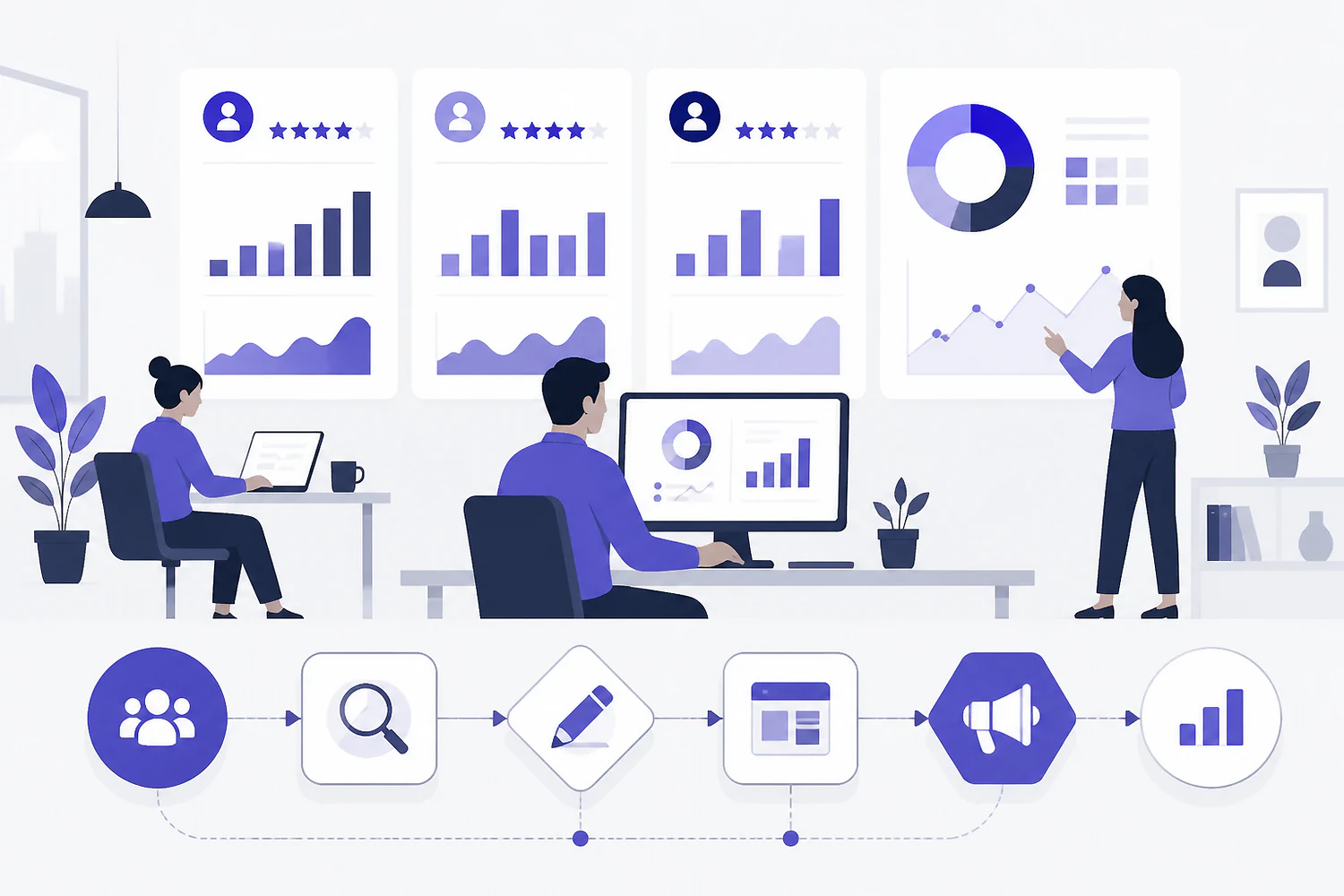
Most agencies, whether they've named it or not, run every client through the same four phases. Prospecting and audits come first: a technical crawl, a keyword and competitor gap analysis, and a baseline of where the site actually ranks, which is what you sell the engagement on. Then on-page and technical execution, the fixes and the content, the part clients picture when they picture SEO. Then off-page and rank tracking, link work plus the ongoing measurement that tells you if any of it landed. And finally reporting, translating all of that into something a client who doesn't think about SERPs all day can read and renew on.
Each phase pulls from a different kind of data, and the naive move is to buy a specialist product for each one. That's how a stack balloons. The better question is how few surfaces you can run all four phases from without giving up the depth any single phase actually needs.
Retention gets decided on whether the client can see the work landing, long before it gets decided on the work itself.
The layers you're actually paying for, whether they're bundled or not.
Strip the branding off every "agency stack" article and you get the same five layers underneath. Knowing them as layers, rather than as a shopping list of products, is what lets you spot where you're paying twice.
- Research and competitive. Keyword volume, difficulty, intent, clustering, and the competitor and keyword gap work that finds the opportunities. Semrush's keyword database is the widest in the market and Ahrefs' backlink index is the deepest, and for pure research depth at the top end they're genuinely hard to beat.
- Technical. The site crawl: indexability, Core Web Vitals, schema, broken links. Screaming Frog and the crawlers own the extreme-depth end of this; most suites cover the everyday version well enough that a separate crawler is a per-client judgment call, not a default.
- Rank tracking, including local. Daily desktop and mobile positions, SERP features, and, for any client with a physical location, rank by geographic point rather than one national average. This last part is where a lot of stacks quietly fail a client.
- AI-answer visibility. New as of the last couple of years and no longer optional: whether ChatGPT, Claude, Gemini, Perplexity, and Google's AI Overviews mention the client when someone asks the AI what they'd have Googled a year ago.
- Reporting and client access. White-label reports, client-facing portals, scheduled sends, and per-project permissions. AgencyAnalytics and DashThis built their whole business here and do it well; the cost is that reporting then sits in a product separate from where the data was measured.
Five layers, and the temptation to buy five products.
The specialist tools are good at their layer. The problem is the seams between them, which the client never sees but your margin does.
Run research in one suite, local rank in a purpose-built local tool, AI visibility in a dedicated GEO product, and reporting in a fourth, and you're paying four subscriptions, reconciling four exports, and stitching one story out of four vocabularies every month. Each product is defensible on its own. The aggregate is a tax on a business whose entire economics are about doing more per hour.
This is the gap Hypado is built for: one workspace that holds Google rank tracking, the local map grid, and AI-answer visibility together, alongside keyword research, backlinks, audits, and competitor analysis. Not "better than Semrush at keyword data" and not "more granular than Local Falcon on a giant grid," but the same five layers on one login, priced as a single subscription instead of four. For an agency, consolidation isn't a nice-to-have feature. It's the line between the work and the overhead.
The AI piece has a second edge that hits agency margins directly. Most suites that bolted on an AI assistant resell their own model as a marked-up add-on. Hypado is MCP-native instead: you add it as a connector inside the ChatGPT or Claude account your agency already pays for, no separate API keys and no AI markup on top. You ask plain-English questions against a client's real SEO data and the assistant drafts the work back as a tracked plan your team can assign and check off. You're not paying a middleman for tokens you've already bought.
The classic stitched stack
A suite, plus a local tool, plus a reporting product.
- ✓ Best-in-class depth in each layer, especially research and backlinks
- ✓ Mature, battle-tested products with big support ecosystems
- × Multiple subscriptions, seat counts, and logins that grow per client
- × Monthly reconciliation across tools that don't share a vocabulary
Hypado
Google rank, local grid, and AI visibility on one login.
- ✓ Five layers in one workspace, one subscription, one report to send
- ✓ Connect the ChatGPT or Claude you already pay for, no AI markup
- ✓ White-label reports, client portals, and per-project access on the Agency tier
- × Newer platform; it doesn't claim to out-depth Ahrefs' backlink index or match a giant purpose-built local grid
The average that hides where your client actually loses.
If any of your accounts has a storefront or a service area, a single national ranking number is close to useless to them, and reporting it as a win is how you get caught out. A restaurant can sit at position three from its own block and fall off page one two miles away, and the blended average papers right over the gap. The fix is a geo-grid: real searches run from a grid of points across the client's target area, scored as a heatmap so you can point at the exact neighborhoods where they're invisible. Hypado runs grids from a single storefront up to metro-wide, and our explainer on geo-grid local rank tracking covers why the average misleads. Local Falcon and BrightLocal are the veterans here and earn it; a client who needs the largest, most granular grid a dedicated tool can produce may well want one of them. For most portfolios, having the grid in the same place as everything else you report is the trade that pays off.
The report your clients are about to start asking for.
A growing share of the queries that used to send your client traffic now get answered inside ChatGPT, Perplexity, Gemini, or Google's AI Overview, with no click. Whether the model names your client in that answer is a new thing to track, and it doesn't show up in any rank report. The honest caveat is that these answers are probabilistic: they vary by run, phrasing, location, and device, so the number to trust is a trend across repeated scans, not a single reading. Hypado builds prompt sets of the questions a client's customers actually ask, runs them on a schedule, and tracks whether the brand appears, how prominently, and which pages and competitors the models keep citing. If you're weighing how much this layer should shape your buying, our piece on choosing an SEO tool that also covers local and AI visibility gets into the specifics. It's the fastest-moving corner of the field, and being able to hand a client an answer on it before they've thought to ask is worth more than it looks.
What a solo consultant needs is not what a fifty-seat shop needs.
The right stack is a function of how many clients, how many hands, and whether you're putting your logo on the reports. Hypado's tiers map to that, and the numbers below are the current published USD prices.
| Plan | Price (USD) | Seats / projects | What it fits |
|---|---|---|---|
| Free | $0 / mo | 1 seat, 1 project, 50 keywords | Testing the platform on a single account; local grid and AI visibility included as a limited taste |
| Starter | $49 / mo | 3 seats, 5 projects, 500 keywords | A solo consultant or tiny team; includes API and MCP access, so connect-your-own-AI starts here |
| Pro | $139 / mo | 10 seats, 20 projects, 1,500 keywords | A growing agency with a real client book; adds work assignment, a workload board, scheduled reports and alerts |
| Agency | $399 / mo | 50 seats, 75 projects, 5,000 keywords | A full agency: adds per-project client access controls, white-label reports and client portals, and priority crawls |
The agency-specific features, white-label output, client portals, and access you can scope to one project, live on the Agency tier, while connect-your-own-AI opens up as early as Starter. Credit top-ups cover the months when research or scanning runs heavy, so a busy stretch doesn't force a whole tier jump. Don't over-buy: start on the plan that matches your current book and move up when the seat or project count actually pinches.
White-label reporting is a retention feature, not a vanity one.
The report is where the client decides whether to renew, so treat it as product, not paperwork. Three things make it carry weight. It has to be branded as yours, because another vendor's logo undercuts the value you're charging for. It has to arrive on a schedule without someone rebuilding it by hand, because manual reports are the first casualty of a busy month. And it should let the client log into a portal and see their own progress between sends, which turns the report from a monthly event into an always-on answer to "is this working." Pair that with a shared action plan the client can watch move, tasks assigned, scheduled, and checked off, and the renewal call stops being a defense and starts being a recap. That's what consolidation actually buys an agency: not just a cheaper tool bill, but a straight line from the data you measured to the story the client renews on.
What SEO tools do agencies use?
Most agencies run a stack across five layers: research and competitive analysis (Semrush, Ahrefs), technical crawling (Screaming Frog), rank and local tracking, AI-answer visibility, and white-label reporting (AgencyAnalytics, DashThis). The trend is toward consolidating those layers to cut the number of subscriptions and logins per client. Hypado folds Google rank, the local map grid, and AI visibility into one workspace with the research, audit, and reporting layers alongside.
What is white-label SEO?
Two related things. White-label reporting means client-facing deliverables carry your agency's branding rather than the tool vendor's, so the client sees your work, not the software behind it. White-label SEO fulfillment is separate: buying SEO work wholesale from another provider and reselling it under your own name, which some agencies use to offer SEO without building the capability in-house. In Hypado, white-label reports and client portals are on the Agency plan at $399 a month.
How do agencies scale SEO across many clients?
By turning the work into a repeatable system and cutting operational drag, not by adding a tool per client. That means running every account through the same phases, automating reporting instead of rebuilding it by hand, using per-project access so clients and contractors see only their own data, and consolidating the tool stack so there's one place to check the whole portfolio rather than logging into several products per account.
Do agencies need to track AI visibility now?
Increasingly, yes. As more searches get answered directly inside ChatGPT, Perplexity, Gemini, and Google AI Overviews, whether a client is named in those answers matters to their traffic, and it doesn't appear in a standard rank report. Track it as a trend across repeated scans rather than a fixed score, since AI answers vary by run, phrasing, and location. Being able to report on it before a client asks is a real differentiator.
Should an agency use one all-in-one tool or several specialists?
It depends on where you need depth. If a specific layer, say the deepest historical backlink index or the largest purpose-built local grid, is central to how you sell, keep the specialist for that layer. For most portfolios, the reconciliation cost of stitching several products together outweighs the marginal depth, and a consolidated workspace that covers all five layers on one login is the more profitable choice.
Run the whole book from one login.
Google rank, the local map grid, and AI-answer visibility in one workspace, connected to the ChatGPT or Claude you already pay for. Start free, no credit card, and put a real client's data in before you decide.