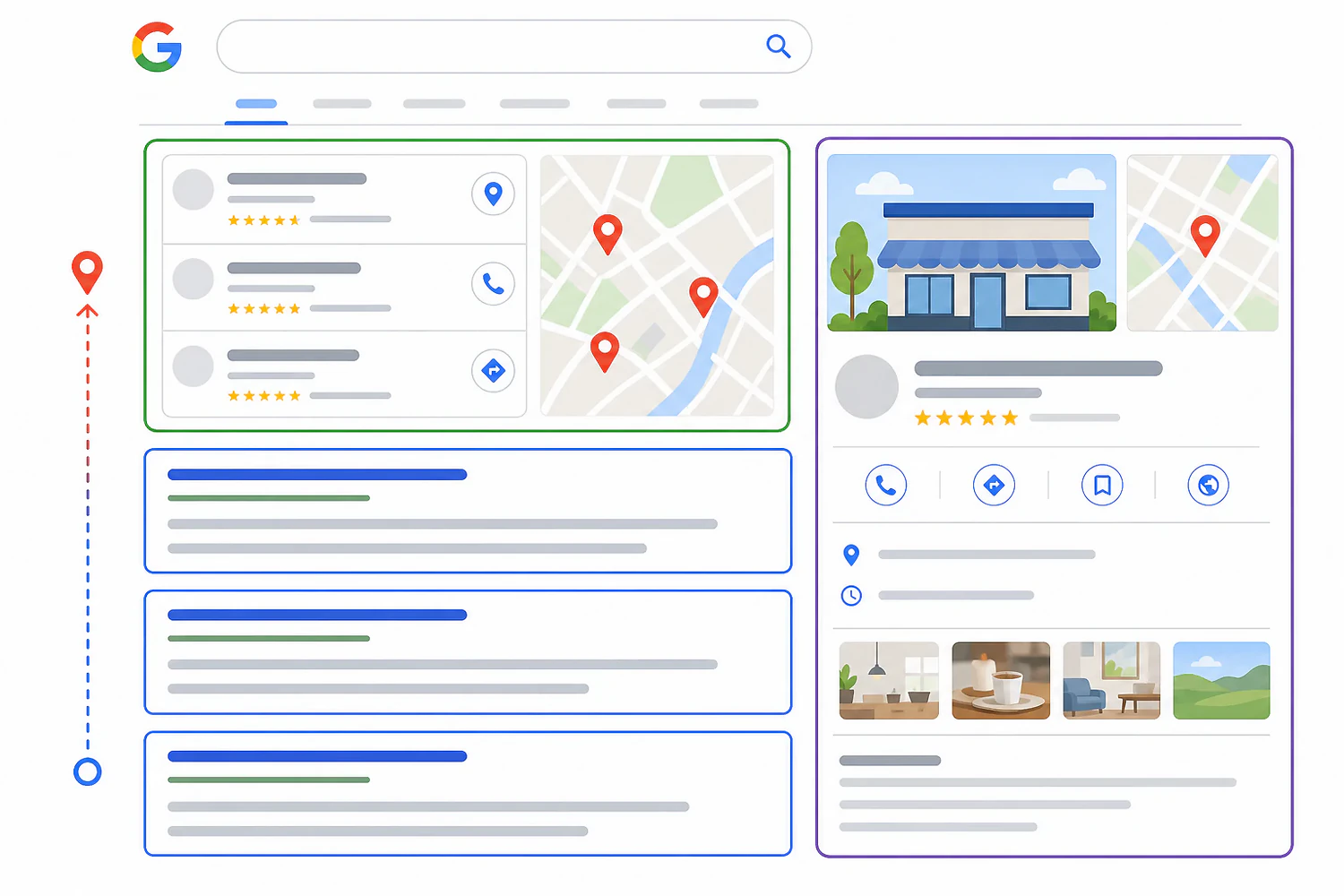
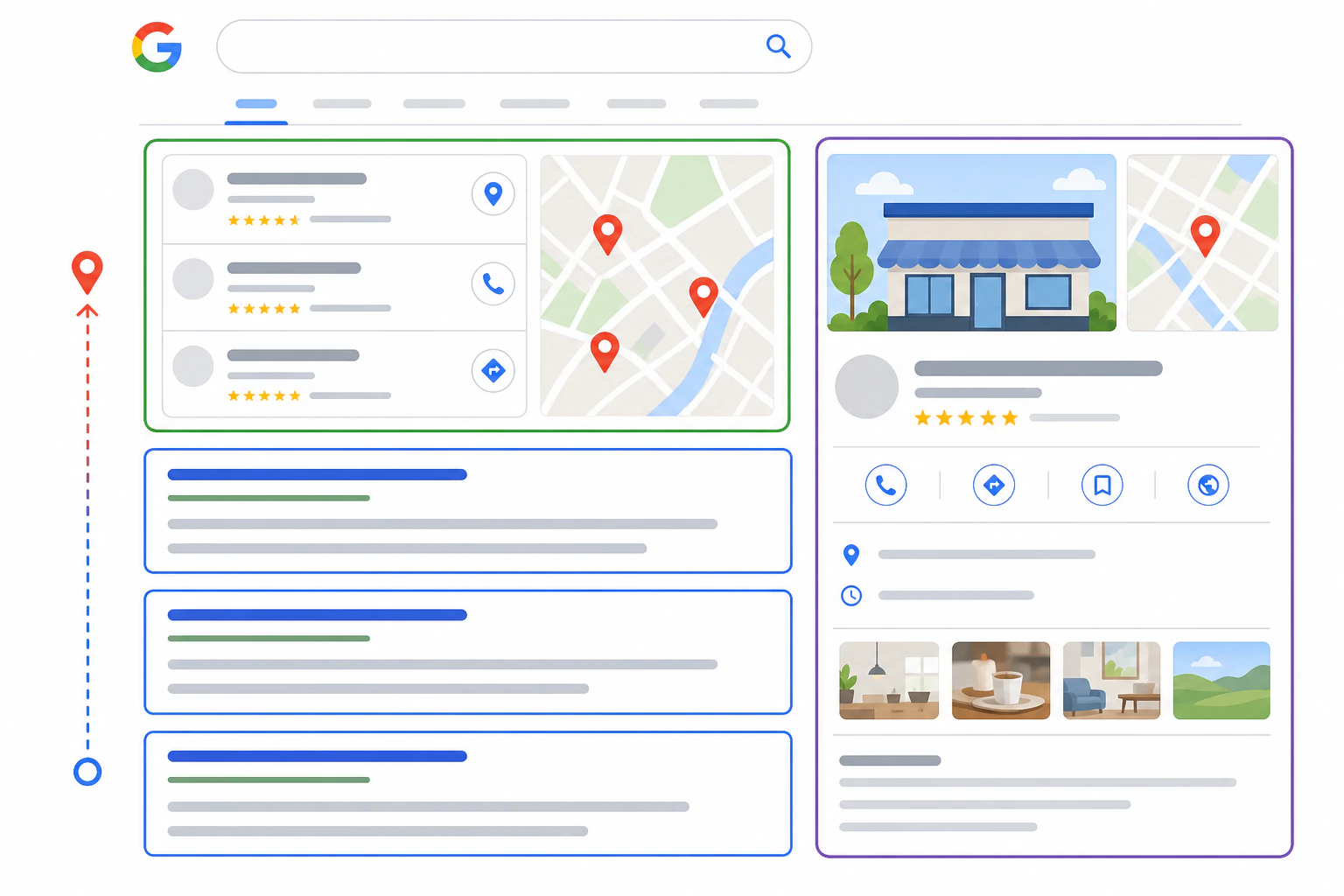
Ranking in the map pack, not just on page one.
78 percent of people who run a local search on their phone visit a business within 24 hours, and roughly a third of those searches turn into a purchase. That's the whole reason local SEO exists: to put your business in front of someone who is close, ready to buy, and about to pick between you and three competitors on the same block. Local SEO is how you earn a spot in Google's map pack (the three-business box with the map) and in the local organic results underneath it. It rewards three things above all: how relevant you are to the search, how close you are to the searcher, and how prominent your business looks to Google. Get those right for the exact spots your customers search from, and you show up. The catch most guides skip is that "showing up" isn't one yes-or-no answer, it changes street by street, which is why measuring it honestly matters as much as doing the work.
Relevance
How well your business matches what the person typed. This is where your Google Business Profile category, your services, and the words on your website do the work. A plumber with "emergency plumbing" spelled out everywhere is more relevant to that search than one whose profile just says "plumber."
Distance
How far you are from the searcher at the moment they search. You can't move your storefront, but distance is exactly why one blended "average rank" is misleading: you can dominate downtown and be invisible three miles out, and Google decides that per search, not per business.
Prominence
How well-known and trusted you look. Reviews (quantity, rating, and how recent they are), links from local sites, mentions across the web, and a complete, active profile all feed this. Prominence is the lever you have the most long-term control over, and it's slow to build.
Two surfaces, one search
A local query gives you two places to win: the map pack up top and the classic blue-link results below it. They rank on overlapping but different signals, so you optimize for both. The map pack leans hard on your Business Profile and reviews; the organic results lean more on your website and links.
The one asset that moves the map pack most.
Ask local SEOs what matters most for map pack rankings and the Google Business Profile comes out on top, well ahead of anything else. It's free, it's the first thing to fix, and a half-finished one is the single most common reason a real business stays invisible.
- Nail the primary category. Pick the most specific category that describes what you actually are, not a broad one. "Mexican restaurant" beats "restaurant." Add secondary categories for the other things you do, but the primary one carries the most weight.
- Fill in everything, then keep it current. Hours (including holiday hours), phone, website, services, products, and attributes. Google favors profiles that are complete and maintained. A profile with wrong hours doesn't just rank worse, it sends someone to a locked door.
- Write a description that reads naturally. Work in the services and neighborhoods you serve without stuffing keywords. This copy increasingly feeds AI-generated answers too, so plain, specific language earns you more than a keyword salad.
- Add real photos, regularly. Storefront, interior, team, and work you've done. Fresh images signal an active business and give searchers a reason to pick you.
- Use Products, Services, and Posts. These are extra surface area to state exactly what you offer, in your own words, tied to your location.
Your Business Profile is a live listing, not a form you fill in once and forget.
On-page signals and a consistent NAP everywhere.
The map pack leans on your profile, but the organic results underneath it lean on your site. That means location matters in your title tags, headers, and body copy, written for humans first. A single-location business usually wants its city and service worked naturally into the homepage and key service pages. A business that serves several areas wants a genuinely unique page per service area, with real, specific content on each. Thin, near-duplicate "we also serve [town]" pages spun up by the dozen are a well-known way to get nowhere, or worse.
Then there's NAP: your name, address, and phone number. The rule is boring and it's non-negotiable: the exact same NAP everywhere it appears, on your site, your Business Profile, and every directory and citation site (Yelp, Apple Maps, Bing Places, industry directories, your local chamber). Inconsistent listings, an old address here, a former phone number there, make Google less confident you're one real business at one real place, and that uncertainty costs you rankings. Citations matter less than they did a decade ago, but consistency across them still matters. Add LocalBusiness schema markup to your site so search engines can read your name, address, hours, and geo-coordinates without guessing.
The signal customers and Google both read.
Reviews pull double duty: they're one of the strongest prominence signals for the map pack, and they're what an actual human scans before deciding to call you. The vast majority of people read reviews before choosing a local business, and a growing share pay attention to whether the owner replies. So the work is ongoing, not a one-time push: ask satisfied customers for reviews as a matter of routine, make it easy with a direct link, and respond to reviews, the good ones and especially the bad ones. Quantity, average rating, and recency all feed the ranking, so a steady trickle of recent reviews beats a burst two years ago and silence since. Never buy reviews or fake them; Google filters them and the penalty isn't worth it.
Links from your own corner of the map.
For the organic side of local search, links are still one of the heaviest factors, and the ones that count most for a local business are local themselves. A link from the chamber of commerce, a sponsored little-league team, a local news write-up, a partner business down the street, or a community event you host is worth more here than a random high-authority link with no geographic connection. Getting listed in relevant local and industry directories does two jobs at once: a citation and, often, a link. This is slow, relationship-driven work, which is exactly why it's defensible once you've built it. Competitors can copy your Business Profile setup in an afternoon; they can't copy ten years of being genuinely woven into your town.
Where you rank depends on where you're standing.
Here's the part a checklist won't tell you. You can do everything above and still not know if it worked, because a single rank number hides the thing that actually matters in local: the same keyword ranks you differently at every point on the map.
Picture an HVAC company that's number one for "ac repair" right at its shop and nowhere on page one four miles away in the suburbs where half its customers live. A tool that reports one average position for that keyword tells you "you're around 5th" and calls it a day. That average is a blend of a green downtown and a red edge of town, and it hides both. What you actually need is a geo-grid, sometimes called a map grid or local grid: a scan that checks your rank from a grid of real geographic points around your location, so you get a heatmap of where you win and where you lose instead of one flattened number. That's how you find the streets to fix and prove to yourself, or a client, that last month's work moved anything. Our own explainer on geo-grid local rank tracking and why an average rank misleads goes deep on how to read one.
Dedicated local tools
Local Falcon, BrightLocal, and similar.
- ✓ Purpose-built for local: the most granular geo-grids, very large grid sizes, GBP monitoring, review and citation management in depth
- ✓ Category veterans with long track records; Local Falcon originated the geo-grid and BrightLocal is a local-SEO institution
- × Local-only, so your Google rank tracking, keyword research, backlinks, and AI-answer visibility live in other tools and other tabs
Hypado
One workspace for local, Google rank, and AI visibility.
- ✓ Local map grid (3x3 for a single storefront up to 11x11 metro-wide), a green-to-red heatmap with visibility percent, average position, and top-3 count per point
- ✓ Same workspace holds your rank tracking, keyword research, audits, and AI-answer visibility, so you stop paying for and stitching together three tools
- × Newer than the incumbents; a team that needs the very largest grid sizes or the deepest dedicated review-management workflow may still prefer a specialist
The honest read: if local-only tracking at extreme grid sizes is your whole job, a specialist earns that. If your local map grid is one piece of a bigger picture that also includes national keywords, site audits, and where AI engines cite you, the argument for one workspace is that you stop reconciling three dashboards that never quite agree. Hypado is also MCP-native, so you can connect the ChatGPT or Claude account you already pay for and ask plain-English questions against your own grid and ranking data, with no separate AI fees and no markup on top. It answers from your numbers and can draft the fixes as a tracked plan you assign and check off.
Getting cited when the answer isn't ten blue links.
More local questions now get answered before anyone scrolls to a website. Google AI Overviews summarize "best taco place near me" straight in the results, and people ask ChatGPT, Gemini, and Perplexity for recommendations the way they used to ask Google. Those answers pull heavily from the same foundations this guide already covers: your Business Profile, your reviews, and structured, specific content. The practical move is to make sure your site is readable to AI crawlers (clean schema, plain content) and that your reviews and profile describe your services and area in the concrete language people actually ask in. Then track it, because these answers shift run to run and by phrasing, so the useful signal is a trend over repeated checks, not a single lucky result. If this is new territory, start with what AI visibility means and why it matters. Hypado folds this into the same workspace as your local grid, tracking whether you show up across ChatGPT, Claude, Gemini, Perplexity, and Google AI Overviews.
How long does local SEO take to work?
Most businesses see early movement in the map pack within roughly 4 to 12 weeks of doing the foundational work, with steadier top-3 positions taking about 3 to 6 months. Low-competition areas move faster, sometimes in 30 to 60 days; dense, competitive markets take longer. It's cumulative, not a switch you flip, so the visibility keeps building as long as you keep at it.
What's the difference between local SEO and regular SEO?
Regular SEO is about ranking your website for a search anywhere. Local SEO adds a geographic layer: you're competing for the map pack and location-specific results, so your Google Business Profile, reviews, NAP consistency, and proximity to the searcher all come into play alongside the usual on-page and link signals. Same core principles, an extra set of levers.
Is Google Business Profile enough on its own?
It's the most important single asset and the first thing to get right, but no. The map pack rewards a complete, active profile plus reviews and prominence; the organic results underneath still depend on your website and links. A great profile with a weak site wins the map pack and loses everything below it.
Why do I rank differently in different parts of my city?
Because distance from the searcher is a live ranking factor, Google shows different results depending on where the search happens. You can be number one at your storefront and off page one across town for the same keyword. That's normal, and it's exactly why a single average rank misleads and a geo-grid that maps your rank point by point is worth using.
Does local SEO work for a service business with no storefront?
Yes. Service-area businesses (plumbers, cleaners, mobile services) can hide their address and set service areas on their Google Business Profile, and can still rank in organic local results with strong service-area pages and reviews. The map pack is a little harder without a verified physical location, so the on-page and reputation work carries more of the weight.
Local SEO isn't one trick, it's a handful of unglamorous fundamentals done consistently: a complete and current Business Profile, a site that says clearly what you do and where, an identical NAP everywhere, a steady flow of real reviews, and links from your actual community. None of it is secret. The part that separates the businesses that win from the ones that plateau is measuring the right thing, your rank across the map and across AI answers, instead of a comfortable average that hides where you're losing.
See where you win and where you don't.
Run a local map grid, track your Google rankings, and check your AI-answer visibility in one workspace. Free to start, no credit card, and you can connect the ChatGPT or Claude account you already pay for.