Local SEO for small business, where the map pack is actually won.
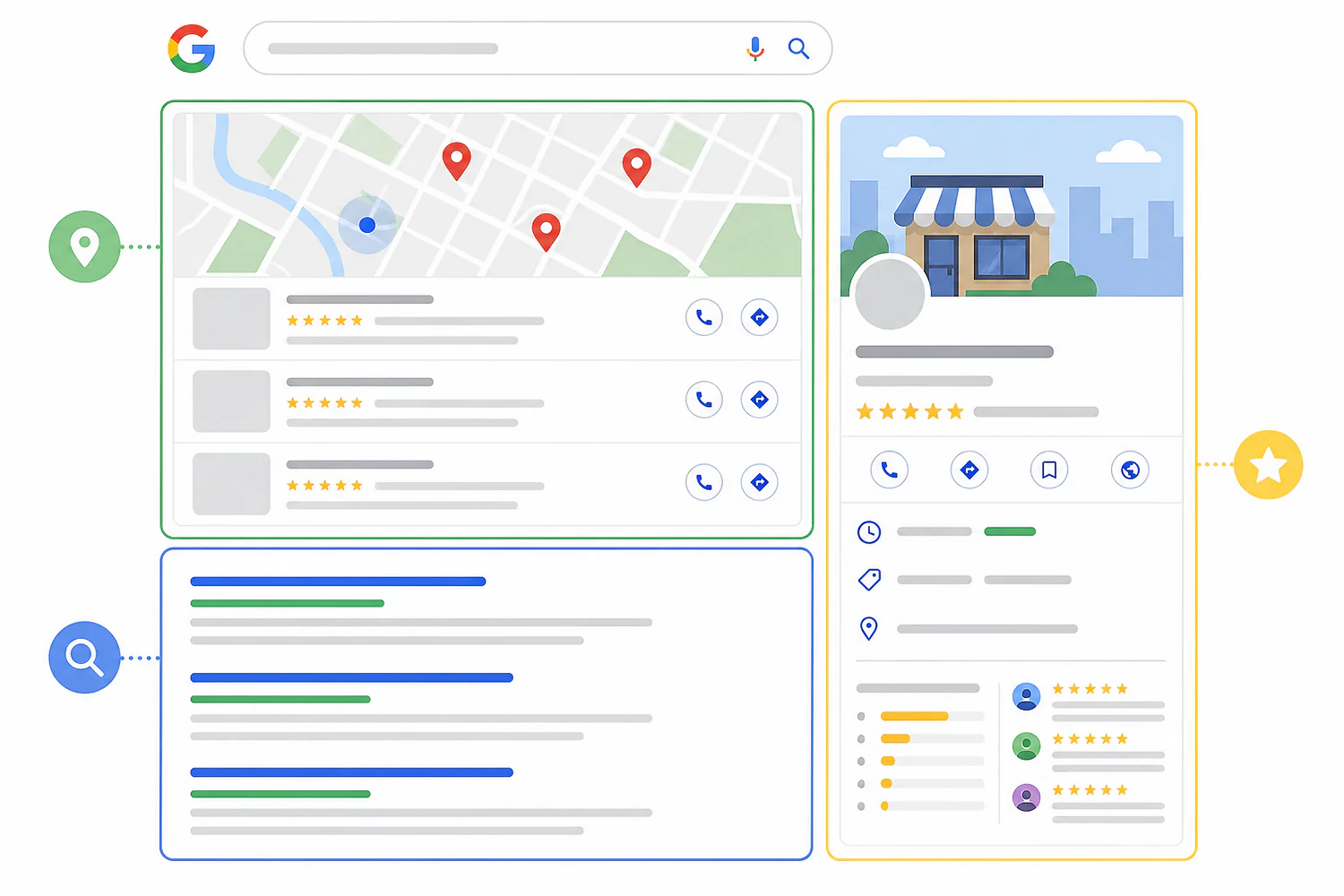
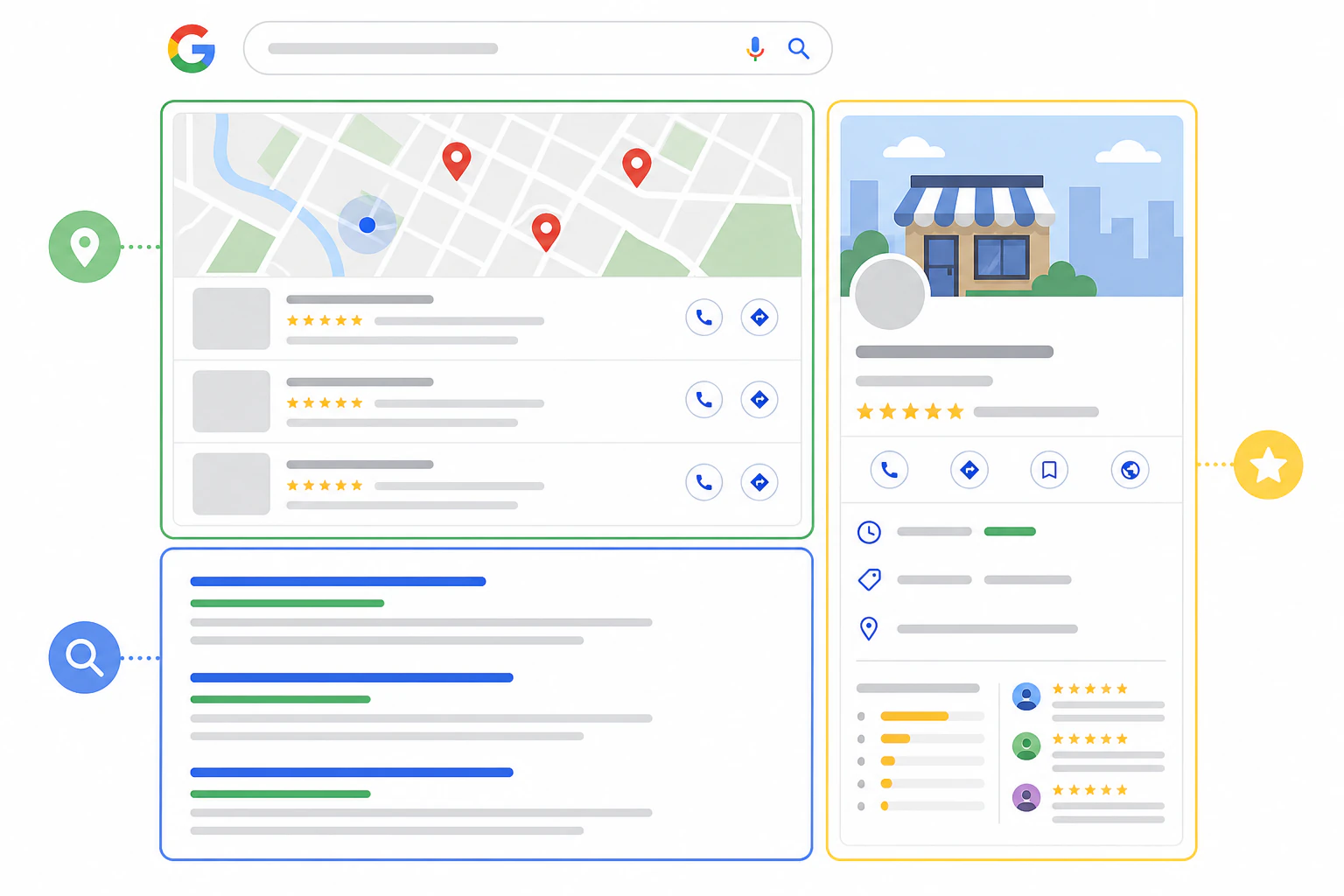
46% of every Google search carries local intent, and 76% of people who run a "near me" search walk into a business within a day. For a plumber, a dental office, or a two-location coffee roaster, that isn't abstract traffic, it's the person three blocks away deciding where to go right now. Local SEO is the work of showing up when they look: ranking in the Google map pack (the three-listing box that sits above the regular results), on Google Maps, and in the plain organic links underneath. Most of it comes down to a well-run Google Business Profile, business details that match everywhere you're listed, a steady flow of reviews, and pages that actually say where you work. None of it is fast, and all of it is doable without hiring an agency.
Three signals, and only one you fully control.
Google's local results come from three inputs. Knowing which is which tells you where effort actually pays off and where you're just spending time.
Proximity
How close you are to the person searching. It's the biggest lever and the one you can't move: someone across town sees a different map pack than someone on your street. You can't fake an address, but you can make sure the one you have is exact and verified, so Google places you where you really are.
Relevance
How well your listing matches what was typed. This is where the work lives: your primary Google Business Profile category, the services you list, the keywords on your site, and the language in your reviews all tell Google what you actually do. A family dentist and a cosmetic dentist should not look identical here.
Prominence
How known and trusted you are: review volume and rating, links from local sites, mentions across the web, even how much people click and call. Prominence is slow to build and hard to fake, which is exactly why it holds. A steady stream of real reviews does more here than any single trick.
What to actually do, in the order that pays.
Skip the 40-item checklists. These are the moves that move rankings for a small local business, roughly in priority order.
- Claim and finish your Google Business Profile. This is the single highest-return thing you can do, and only about a third of small businesses have even claimed one. Verify it, pick the most specific primary category you can, add every service, real photos, hours, and your service area. Post updates. Answer the Q&A. A complete profile is the difference between showing in the map pack and not existing there.
- Make your NAP identical everywhere. Name, address, and phone number should match character for character across your website, Google, Yelp, Apple Maps, Bing Places, and every directory that lists you. "Ste 200" in one place and "Suite 200" in another is the kind of small mismatch that quietly suppresses rankings. Pick one format and enforce it.
- Ask for reviews, and answer them. Reviews are one of the heaviest local signals there is, and 97% of people read them before choosing. Make asking a routine, right after the job's done, and reply to every one, including the bad ones. Steady review velocity beats a burst of ten and then silence for a year.
- Target the words people actually type. Emergency plumber plus your city, 24 hour vet near me, wedding florist plus the neighborhood. Put those phrases where they belong: page titles, headings, body copy, image alt text. Not stuffed, just present and honest. Long, specific queries convert far better than the broad head term everyone chases.
- Build a real page per location and per service. One thin "areas we serve" page listing 30 towns fools no one. Each location gets its own page with its own address, map, hours, and locally written copy; each core service gets a page that goes deep. Add LocalBusiness schema so Google can read your details cleanly.
- Get listed and get linked locally. Consistent citations on the major directories build trust, and a handful of genuine local links (a chamber of commerce, a sponsored little-league team, a writeup in the local paper) do more than a pile of generic backlinks. Local relevance is the whole point.
Not every factor pulls the same amount.
The rough weighting from the 2026 local search ranking factors survey, so you know what deserves your Tuesday afternoon.
| Signal | Approx. weight | What it means in practice |
|---|---|---|
| Google Business Profile | ~32% | Categories, completeness, verification, service area, posts |
| Reviews | ~20% | Volume, rating, recency, your replies, keywords in the text |
| On-page SEO | ~19% | Local keywords, titles, location pages, NAP on site, schema |
| Links | ~15% | Local and relevant backlinks to your site |
| Behavioral | ~8% | Clicks, calls, direction requests, dwell |
| Citations | ~7% | Consistent NAP across directories |
Two things jump out. First, more than half your ranking fate lives in your Google Business Profile and your reviews, both free and both fully in your hands. Second, the tactics people obsess over, chasing links and mass-submitting to directories, sit near the bottom. Get the top of the table right before you touch the rest.
Your business can rank number one on your own block and be invisible three neighborhoods over, and one average position number will never tell you that.
The number that hides where you're losing.
You can do everything above and still not know whether it worked, because the standard way of measuring local rank is built to mislead you.
Most rank trackers give you one position for a keyword: you rank 4th for "emergency plumber." But local results shift with every step the searcher takes. Proximity is the strongest signal, remember, so your rank isn't a number, it's a map. You might sit in the top three within a mile of your shop and fall off page one across town, and a single blended average position flattens that into one tidy figure that hides the exact blocks where you're losing calls to a competitor.
The honest way to see it is a local map grid: the tool checks your rank from a grid of real geographic points spread across your service area, then draws a heatmap. Green where you're in the top three, red where you've dropped off page one. Now you can see that you own downtown and lose the suburbs, and you can aim your location pages and review requests at the exact area that's red. We wrote a full walkthrough of why geo-grid local rank tracking beats a single average if you want the mechanics.
Credit where it's due: Local Falcon pioneered the geo-grid and scans at grid sizes a hyper-local specialist will want, and BrightLocal has been a local-SEO institution for years, with grid tracking, citation tools, and review monitoring in one place. If dedicated local-only tracking at extreme grid density is all you need, they're excellent and you should use them.
People ask an AI now, not just a search box.
Roughly 45% of consumers now ask ChatGPT or another AI tool for local business recommendations, and getting mentioned there is reportedly far harder than ranking in Google's local pack. That's a second map you can't see with a rank tracker. When someone asks an assistant "best family dentist near me," does it name you, a competitor, or nobody? You won't know unless you check on a schedule, because AI answers shift run to run and by how the question is phrased. Tracking whether you show up, and how you trend over repeated scans, is its own discipline; here's a plain explanation of AI visibility and why local businesses should care.
One workspace, instead of a stack of tabs.
Where Hypado fits: it folds the three local surfaces you now have to watch into a single view.
The map grid
Run the geo-grid from a 3x3 grid over a single storefront up to 11x11 across a metro, on a schedule, and watch the heatmap instead of an average. See visibility percentage, average position, and where you sit in the top three, block by block.
AI answer visibility
Build prompt sets of the questions your customers actually ask, and track whether ChatGPT, Claude, Gemini, Perplexity, and Google AI Overviews mention you, in what order, and against which competitors, as a tracked trend over repeated scans rather than a one-off guess.
Google rank and the rest
Daily desktop, mobile, and local rank tracking, keyword research, site audit, and competitor analysis alongside the grid and the AI data, so local visibility isn't a separate subscription bolted onto everything else you run.
The differentiator worth knowing: Hypado is MCP-native, so you add it as a connector inside the ChatGPT or Claude account you already pay for, no developer API keys, and there's no AI markup added on top. You ask plain-English questions against your own local data ("which grid points went red this month, and what should I fix first?") and the assistant drafts the answer as a tracked plan your team can assign and check off. The honest caveats: Hypado is a newer platform than the incumbents, that connect-your-own-AI flow assumes you already have ChatGPT or Claude, and the free tier's grid and AI features are a limited taste. It's free to start with no credit card, which is enough to see your own heatmap before deciding anything.
How much does local SEO cost for a small business?
The core work is free to do yourself: claiming and optimizing your Google Business Profile, fixing your NAP, asking for reviews, and writing location pages cost time, not money. If you hire it out, small-business local SEO retainers commonly run from a few hundred to a couple thousand US dollars a month depending on scope and competition. Tools sit in between; several, including Hypado's free tier, let you track the map grid and rankings at no cost to start.
How long does local SEO take to work?
Finishing your Google Business Profile can move you into the map pack within a few weeks. The rest, reviews, links, and prominence, builds over three to six months and keeps compounding. Anyone promising page one in a week is selling something. Local SEO is a slow, durable advantage, not a switch.
Can I do local SEO myself, without an agency?
Yes, and most of the high-value work is exactly the kind a business owner can do: your profile, your reviews, your NAP, your pages. An agency helps most with links, content at scale, and multi-location complexity. If you're a single location, start by doing the playbook above yourself and only pay for help where you genuinely run out of time.
What's the difference between local SEO and regular SEO?
Regular SEO competes for a keyword everywhere; local SEO competes for it near a physical place. Local adds the map pack, Google Business Profile, proximity, NAP, and reviews to the usual on-page and link work. The upside for a small business is a smaller field: you're up against businesses in your area, not the entire web.
Do reviews really affect local rankings?
Yes, heavily. Reviews are among the largest local ranking signals, roughly a fifth of the weight, and they factor in beyond the star count: volume, how recent they are, whether you reply, and even the words reviewers use. You can't pay for reviews, but you can build a habit of asking every satisfied customer, which is the honest and effective route.
See the map, not the average.
Do the playbook first, it's free and it works. Then, if a single rank number has been hiding where you actually win and lose, connect the AI you already use and watch your own heatmap.