Rank higher where the customer is actually standing.
Picture an HVAC company that shows up first in the map pack when the owner searches from the front desk, and nowhere at all when a homeowner three miles across town searches the same words. Same business, same day, two completely different results. That gap is the whole game. To rank higher on Google Maps you optimize your Google Business Profile for the three things Google weighs (relevance, distance, and prominence), prove it with a specific primary category, a steady flow of reviews, a consistent name, address, and phone number, and a real website behind the listing, and then you check your position from more than one spot on the map. That last part is where most businesses fly blind.
Relevance
How closely your profile matches what someone typed. This is the factor you control most directly: the right primary category, accurate services, a description that names what you actually do, and a website that backs it all up. Get the category wrong and you rank for the wrong searches, or none.
Distance
How far you are from the person searching. Google recalculates the map for every searcher, and proximity gets heavy weight, so a listing that dominates within a block or two fades as the searcher moves away. You can't move your storefront, but distance is exactly why a single average rank number misleads you.
Prominence
How well known and trusted your business is. Reviews (quantity, quality, and how recent they are), citations across the web, links from local sites, and general activity all feed this. Prominence is the slow-burn factor, built over months, and it's the one that lets you outrank a closer competitor.
Fix the profile first, because nothing else compensates for a thin one.
A complete, verified Google Business Profile is the floor. You can chase links and reviews all year, but if the profile itself is half filled in or unverified, Google has no reason to trust it.
- Claim and verify the listing. An unverified or unclaimed profile is one of the most common reasons a business simply doesn't appear. Verification (postcard, phone, email, or increasingly a short video) tells Google the business is real. Nothing below matters until this is done.
- Pick the most specific primary category you can. Whitespark's 2026 local ranking factor survey puts the primary category at the top of the list for Maps. "Mexican restaurant" beats "restaurant." Add secondary categories for the other things you genuinely do, but the primary one has to name your core offering exactly.
- Make your name, address, and phone number identical everywhere. NAP consistency is worth a real slice of local ranking power. Use your true business name (not a keyword-stuffed version, that violates Google's guidelines and can get you suspended), a local phone number rather than a toll-free one, and match every character, down to "St" versus "Street," across your site and every directory.
- Fill in every field. Hours including holidays, services and products from Google's predefined lists, attributes, a description up to 750 characters that works in the terms customers search, and the correct map pin placement. Businesses with complete info show up more often, full stop.
- Add real photos, and keep adding them. A useful floor for most local businesses is 25 to 30 images: exterior, interior, product or work shots, and a couple of the team. Fresh photos are also an activity signal, so this isn't a one-time upload.
- Seed the Q&A and post regularly. Answer the obvious questions yourself before someone else answers them wrong, and use Google Posts to keep the listing active. Google favors profiles that look tended, not abandoned.
There's no button to pay Google for a better local rank. Every ranking business earned the position with signals you can also build.
The prominence engine you can actually turn.
Reviews are the lever most businesses under-use, and they move Maps more than almost anything else you can do this quarter. It isn't only the star average. Google reads the volume, the recency, and the words inside the reviews, which is why a steady trickle of two or three genuine reviews a week beats forty in a single burst followed by silence. Build the ask into the actual moment of service: a QR code at checkout, a follow-up text, staff who mention it by name. Then respond to all of them, the good and the bad, within a day or two, because responses are a visible activity signal and because how you handle a one-star review is read by every future customer.
What you can't do is buy or fake your way there. Incentivizing reviews with discounts, gating out the unhappy ones, or posting them yourself all violate Google's policies and increasingly get caught. The durable move is boring: consistently earn real reviews from real customers and reply to every one.
Citations and local links, the trust Google reads elsewhere.
Prominence is partly built off your profile, in the signals Google finds about you across the rest of the web.
- Build consistent citations. List the business on the directories that matter (Yelp, Bing Places, Apple Maps, Facebook, plus the ones specific to your industry) with that exact same NAP. Inconsistent citations quietly drag you down, so fix the mismatches before you chase new listings.
- Consolidate duplicate listings. Two profiles for one location split your signals and confuse Google. Find the duplicates and merge or remove them.
- Earn local backlinks. Join the chamber of commerce, sponsor a local team or event, partner with complementary nearby businesses, or give the local press something worth covering. A handful of genuinely local links does more for Maps than a pile of generic ones.
- Back it with a real website. A location or service page with unique content, local keywords in the title and headings, an embedded map, and LocalBusiness schema markup (name, address, phone, hours, geo-coordinates) reinforces everything the profile claims. Validate the schema with Google's Rich Results Test so it actually parses.
You can't fix what one averaged number hides.
Here's the trap in that HVAC scenario from the top. If you check your rank by searching from the office, or you read a single "average position" in a tool, you get one flattering number that erases the entire map. You're number 3 on average, and the average is meaningless, because it's number 1 near you and off the map where half your customers live.
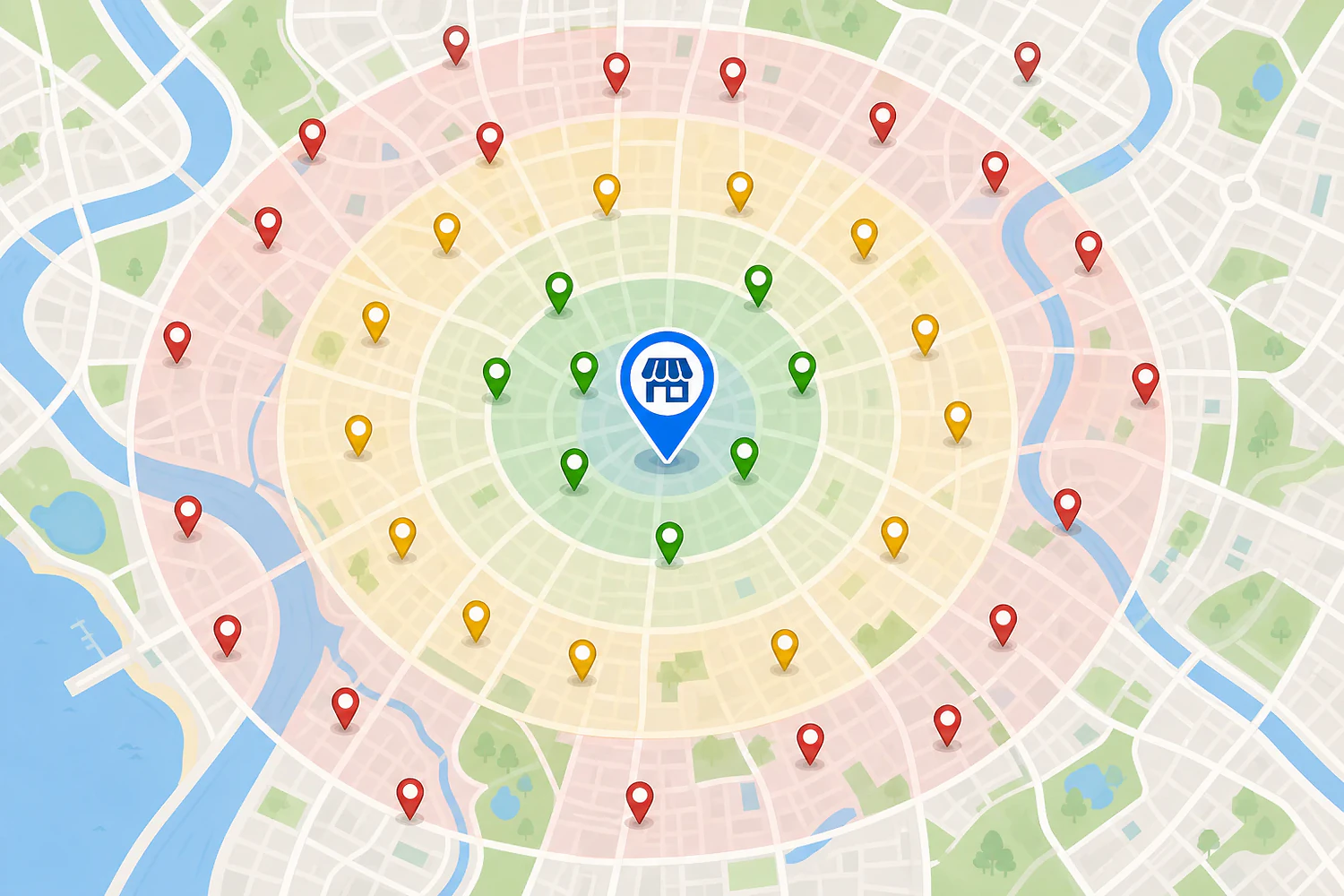
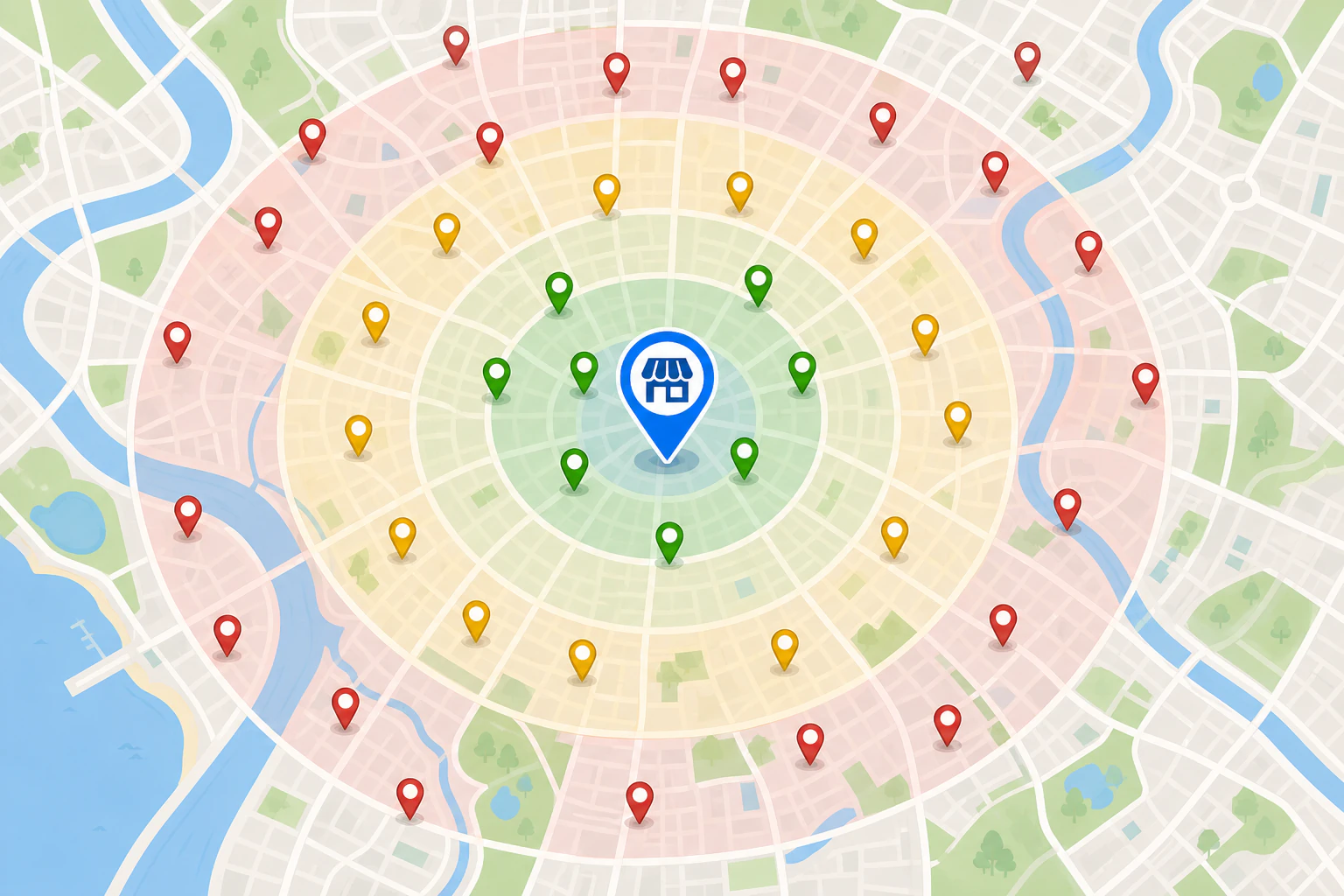
The fix is to measure position as a geographic grid, not a single point. A local grid drops a set of pins across your service area, runs the actual search from each one, and colors the result: green where you land in the top three, red where you've fallen off page one. Now the pattern is visible. You can see you own the blocks around the storefront and vanish two neighborhoods over, which tells you exactly where to point your next citation push, your next batch of reviews, or a location page aimed at the suburb you're losing. If you want the full reasoning on why an average misleads and how the grid exposes it, we walk through it in local grid rank tracking explained.
Plenty of tools do this well. Local Falcon originated the geo-grid and scans at extreme grid sizes; BrightLocal has been a local-SEO institution for years with its own grid and citation tooling. If a granular, local-only tracker is all you need, they're excellent. Hypado's angle is different: the local map grid (grids from 3x3 for a single storefront up to 11x11 for a metro, with visibility percentage, average position, and top-3 counts per scan) lives in the same workspace as your Google rank tracking, keyword research, and AI-answer visibility, so you're not paying for and stitching together three separate tools. And because it's MCP-native, you can connect the ChatGPT or Claude account you already pay for and ask plain-English questions against your own grid data, with no separate AI fees. It's a newer platform than the incumbents, so if a deep historical index is your priority, weigh that honestly. For seeing where you win and lose on the map, and turning that into a plan, it earns its place.
How long does it take to rank higher on Google Maps?
Profile edits like hours or photos can appear within minutes. Bigger changes (a category switch, an address update, a reinstatement, or video verification) can take several days. Actual ranking improvement from reviews, citations, and links is a compounding effort measured in weeks and months, not days, and positions fluctuate constantly as Google tests result sets and competitors make their own moves.
Why is my business not showing up on Google Maps?
The usual suspects: the profile isn't verified, it's a duplicate or was suspended, the NAP is inconsistent across the web, the primary category is wrong, or the searcher is simply too far away. Proximity is the one you can't fully control, which is exactly why checking your rank from a grid of locations, not just your own, tells you whether it's a distance problem or a fixable profile problem.
Can I pay Google to rank higher in the map pack?
No. There's no paid shortcut to the organic local pack. You can run Local Services Ads or a Google Ads location extension, which are clearly marked ads and sit separately, but the three organic map results are earned through relevance, distance, and prominence. Anyone promising to buy your way in is selling something Google doesn't offer.
Does adding keywords to my business name help?
Stuffing keywords into your business name (listing "Joe's Plumbing Emergency Drain Repair Cheap" when the sign just says "Joe's Plumbing") is a direct violation of Google's guidelines. It can give a short-term bump, and it can also get the whole listing suspended when a competitor reports it. Use your real name and earn relevance the legitimate ways instead.
How many reviews do I need to rank in the top three?
There's no magic number, because it's relative to your competitors in your area and category. What matters more than a fixed count is a steady, ongoing flow of genuine reviews, a healthy average, recent dates, and your responses underneath them. A competitor with 60 fresh reviews will usually outrank one sitting on 200 that stopped two years ago.
See where you actually rank, pin by pin.
Run a local grid on your main keyword and watch the map light up green and red. Free to start, no credit card, and you can connect the ChatGPT or Claude account you already have to read the results.