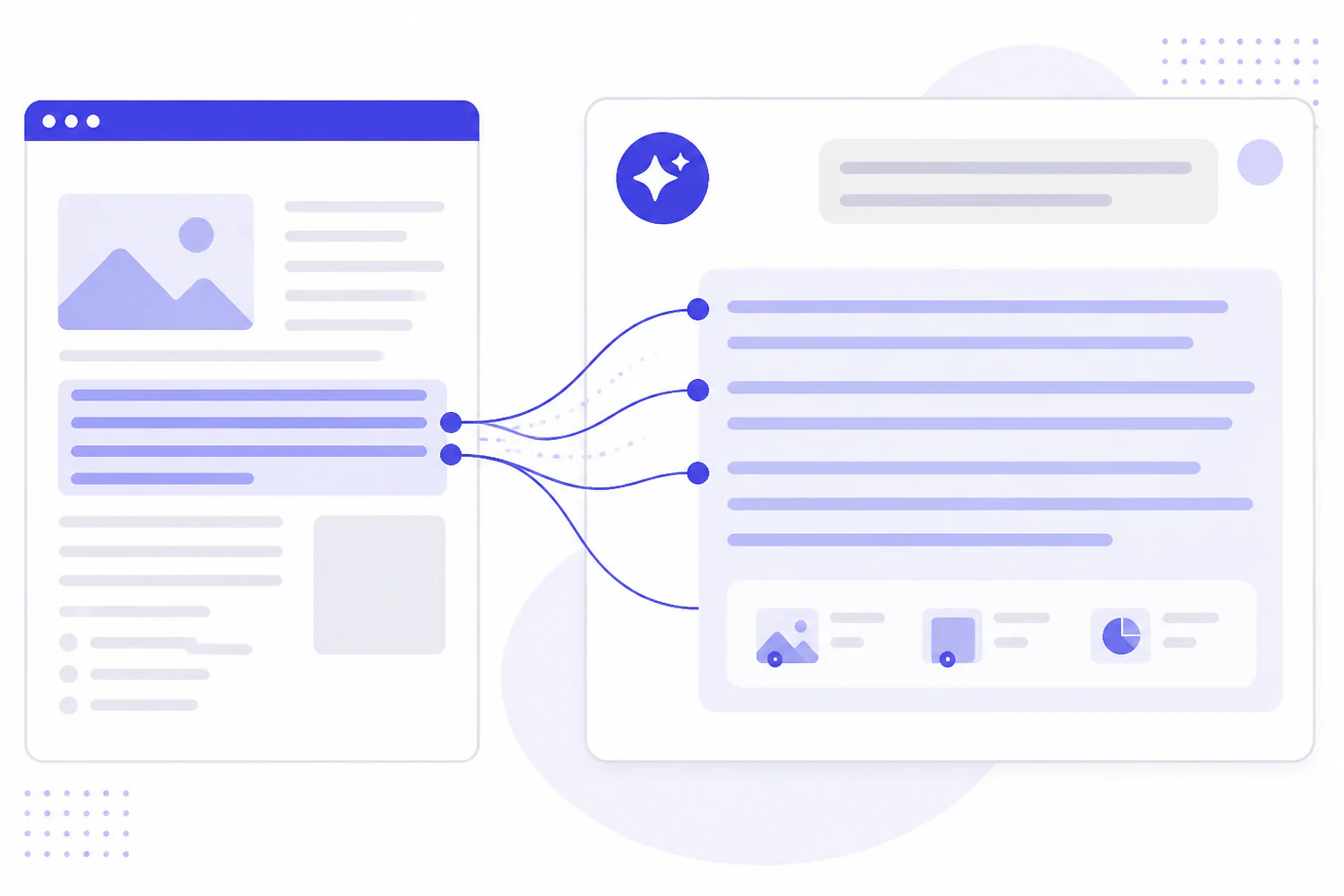
Thousands of pages could answer. The engine cites five.
Getting cited by ChatGPT takes three things working at once: a page the engine can retrieve (crawlable by AI bots and indexed where it searches), a passage it can lift whole (the answer stated plainly, with a number or a source attached), and enough corroboration across the web that naming you looks safe. None of that is exotic. The part almost everyone skips is verification: running the same questions on a schedule and watching which citations you gain and lose from scan to scan.
An AI answer has no page two. When ChatGPT writes four paragraphs about the best CRM for a small agency, it grounds them in a handful of sources and names those. Every other page that could have made the cut simply doesn't exist for that user, and the miss never shows up in your analytics because nobody clicked anything. That's the premise behind generative engine optimization: the citation is the unit of visibility now, and it can be worked toward deliberately.
Two facts about citations shape everything below. First, they concentrate. Store enough AI answers for the same set of questions, as we do at Hypado, and the same domains recur far more often than chance: a few aggregators, a few reference sites, a few brands. Second, they wobble. Ask the identical question twice in one afternoon and the citation list shifts. Both facts matter. Concentration means there's a repeatable pattern you can work toward. Wobble means a single screenshot of ChatGPT citing you proves almost nothing, and the real scoreboard is the trend across repeated runs.
What AI engines actually cite when they name names.
Across public citation studies and the answer sets we store, the mix for commercial questions is consistently third-party heavy. Engines prefer sources that compare, aggregate, or review over the brands being compared.
That has an uncomfortable implication. For the highest-intent questions ("best X for Y," "X vs Z," "is X worth it"), your own site is often not the page the model reaches for. It grounds those answers in pages that look neutral. Your site earns citations for the questions only you can be the primary source on: your pricing, your specs, your documentation, your original data. Everything else routes through pages other people run, which makes getting onto those pages a citation tactic, not a PR afterthought.
| Source type | Why engines lean on it | Your play |
|---|---|---|
| Comparison posts and "best of" roundups | They match the question's shape: one page, many options, verdicts included | Find the roundups that keep getting cited for your queries and pitch your way in |
| Review platforms and directories | Structured ratings read as neutral evidence | Claim and complete your profiles, and keep reviews coming on the platforms your category actually uses |
| Community threads (Reddit, industry forums) | Unpolished opinions from real users, which engines treat as ground truth for "what do people think" | Be genuinely useful where your buyers already ask questions; never astroturf |
| Reference entries (Wikipedia and similar) | Pre-vetted, entity-rich, safe to attribute | Hard to influence and easy to get penalized trying; correct factual errors through proper channels and leave it there |
| Your own docs, pricing, and data pages | Primary source for facts about you, plus original numbers nobody else has | Publish real prices in USD, real specs, and data worth citing, then keep them current |
What makes a passage quotable to a machine.
The academic work that named GEO found the biggest visibility gains came from adding statistics, quotations, and sourced claims, up to roughly 40 percent in its tests, while keyword density did nothing. Every trigger below follows from the same mechanic: engines lift passages, so they favor passages that survive being lifted.
A number it can repeat
Models lift concrete figures first: a price, a percentage, a benchmark with a date. "Setup takes about 90 seconds" gets quoted; "quick setup" doesn't. Attach a source to the number and you've handed the engine a citation-shaped fact.
The answer before the context
Treat every heading as a question the model might be answering, and put the direct answer in the first sentence underneath it. If your answer arrives three paragraphs in, the engine quotes whoever put it first.
Passages that stand alone
Retrieval pulls passages, not pages. A paragraph that leans on the previous one ("this approach," "it also") dies out of context. Name the entity and restate the subject, and each paragraph becomes independently citable.
Headings shaped like real questions
Match the phrasing people type into the chat box, not your internal vocabulary. "How much does X cost" beats "Pricing philosophy" because retrieval matches the passage to the question first and judges quality second.
Structure that survives extraction
Tables, tight lists, and short definitions come through extraction intact. A comparison table is nearly pre-written answer material; a 600-word narrative making the same points has to be reassembled, and often isn't.
A date it can trust
For anything volatile (prices, versions, statistics), engines lean toward sources that look current. Show a real last-updated date and refresh the figures behind it. A 2023 number on an undated page is a reason to cite someone else.
The pages that get cited are the ones a model can quote without cleaning up.
A citation-worthiness audit for your money pages.
Run this against the five or ten pages you most want cited. Every item is checkable in an afternoon.
- AI crawlers can reach the page. Check robots.txt for GPTBot, OAI-SearchBot, ClaudeBot, and PerplexityBot, and confirm the main content renders without JavaScript. A blocked or JS-only page can't be retrieved, so it can't be cited.
- It's indexed in Bing. ChatGPT's live browsing leans on Bing's index, and a page missing there is invisible to it. A quick site: search and Bing Webmaster Tools settle this in minutes.
- The answer sits in the first two sentences. Under a heading that matches the question, in plain declarative language. Save the nuance for the paragraphs after the answer, not before it.
- Every key section carries a fact. A price in USD, a spec, a dated statistic, a named source. Sections built entirely from adjectives give the model nothing to quote.
- Passages make sense out of context. Read each paragraph alone. If it needs the one above it to parse, swap pronouns for names and restate the subject.
- The entity is unambiguous. Who you are, what you do, and for whom, stated consistently across the site and reinforced with Organization, Product, and FAQ schema. Engines cite brands they can identify cleanly.
- There's a visible, honest date. And the numbers behind it were actually refreshed. Updating the date without updating the figures is the kind of thing that gets a source dropped.
- The page gives aggregators a reason to cite you. Original data, real pricing, benchmarks only you can publish. Third-party pages win the comparison citations, and they need raw material; be the primary source they attribute.
None of this works in a vacuum. Citations follow reputation: engines name brands they've seen recommended across roundups, reviews, forums, and coverage far more readily than brands that only talk about themselves. And because live retrieval reads a small set of top-ranked results, classic ranking work still feeds the machine. Both halves, the off-site mentions and the search rankings underneath them, are covered in our guide on how to rank on ChatGPT, which pairs with this piece.
Treat citations like rankings: a trend, not a trophy.
LLM answers vary run to run, and by phrasing, location, and device. The only honest way to know whether any of the work above is paying off is repetition: the same questions, on a schedule, every answer stored, citations counted over time.
The loop looks like this. Write down the 20 to 50 questions your customers actually ask, in their words, not your keyword list's. Run them on a schedule and track four things: how often your pages get cited across the set, which citations are new since the last scan, which ones you lost, and which domains keep taking the citations you want. That last list may be the most useful output of the whole exercise, because the domains that keep beating you are your outreach list. It's the citation-shaped slice of what AI visibility means, narrowed to one number you can act on.
This is the job Hypado's AI visibility tracking was built around. You create prompt sets (folders of real customer questions), Hypado runs them on a schedule across ChatGPT, Claude, Gemini, Perplexity, and Google AI Overviews, stores every answer, and flags new and lost citations along with the pages, domains, and competitors the engines keep relying on. It also checks whether AI crawlers can reach your site at all, the llms.txt and schema items from the audit above. And because it sits in the same workspace as your rank tracker, you can watch whether the page you pushed onto Google's first page starts picking up citations a few weeks later, which is usually the order things happen in. If you want the same loop for unlinked brand mentions rather than linked citations, we've written up how to track brand mentions in ChatGPT separately.
Two honest caveats. A team that's already standardized on a dedicated GEO monitor has no urgent reason to switch just for citation counting; several tools in that category do it well. And no tool, ours included, turns a probabilistic system into a guaranteed one. A citation you hold on seven of ten runs this month can slip to five of ten next month without anything being wrong. What tracking buys you is the ability to tell that noise apart from a real trend, which is the difference between reacting to a screenshot and running a program.
What people ask before they start.
How do I get my website cited by ChatGPT?
Make the page retrievable (crawlable by GPTBot and OAI-SearchBot, indexed in Bing), make the answer extractable (stated plainly at the top of a matching section, with a statistic or source attached), and build third-party corroboration so the model has seen you recommended somewhere other than your own site. Then verify with repeated scans rather than a one-off check, because answers vary between runs.
Does ChatGPT always cite its sources?
No. When it browses the web it usually attaches citations to what it retrieved. When it answers from trained knowledge it often names brands without linking to anything. Both surfaces matter: the retrieval path responds to on-page work within weeks, while the trained-knowledge path rewards a long, consistent record of mentions across the web.
How long does it take to get cited by AI?
Through live retrieval, a crawlable page that's genuinely the clearest answer can start appearing in cited answers within days to weeks of being indexed. Becoming a brand the model names from memory moves on training-cycle timescales, months and longer. Track your prompt set on a schedule so you can tell which path is actually moving.
Can you pay to be cited by ChatGPT?
No. There's no paid placement inside the organic answer, and where AI platforms experiment with ads, those units are labeled and separate from citations. Treat any guarantee of AI citations as a red flag: the citation set isn't for sale, and it varies from run to run.
Does llms.txt help you get cited?
It's cheap to add and can't hurt, but adoption by the major engines is unproven, so don't expect it to move citations on its own. Crawlability, Bing indexation, and extractable content do the heavy lifting. Add llms.txt as the five-minute item at the end of the checklist, not the strategy.
See who the engines cite before you guess.
Build a prompt set from your customers' real questions and watch your citations move scan over scan. Free to start, no credit card.