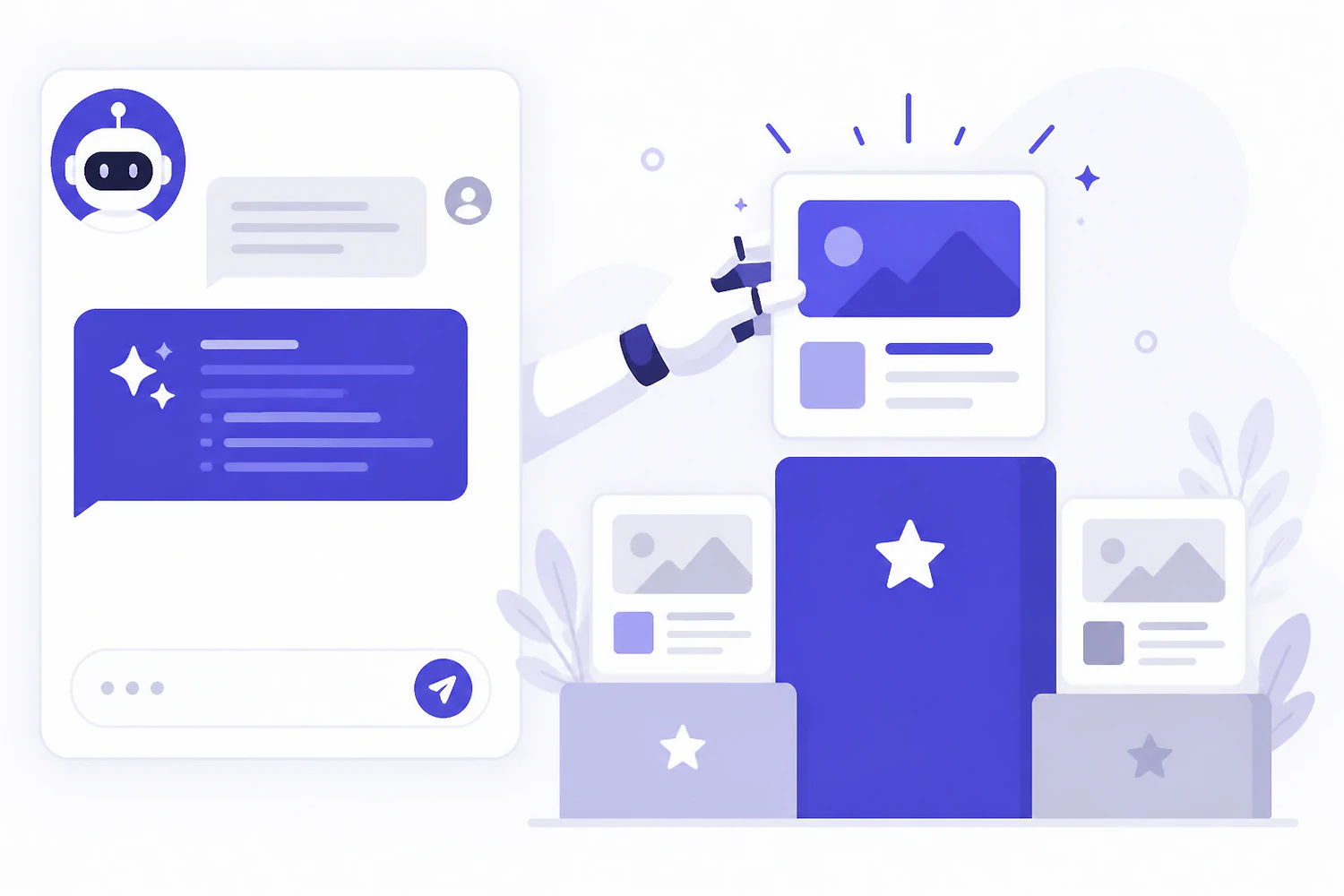
You don't rank on ChatGPT. You get cited by it.
There's no position 1 to climb to inside ChatGPT and no results page to fight your way up. When someone asks it "what's the best project-management tool for a small agency" or "who does commercial roofing near me," ChatGPT writes a paragraph and names a handful of brands. Ranking, in this world, means being one of the names it writes down. You earn that by being the source it trusts and can pull from when the question comes up, which is a different job than earning a blue link, and the moves that get you there are concrete. Here's what actually moves the needle, and how to tell whether any of it is working.
Two paths get you into an answer, and they run on different clocks.
ChatGPT surfaces your brand through two mechanisms, and it helps to keep them separate because they respond to different work and pay off on different timelines.
The first is live retrieval. When ChatGPT browses the web to answer a current question, it leans heavily on Microsoft Bing's search index, reads a small set of top results, and grounds its answer in what it finds, often with visible citations. This path is fast. If your page is crawlable, indexed in Bing, and genuinely the clearest answer to the question, you can start appearing as a cited source within days of publishing rather than the weeks or months a Google ranking takes to settle.
The second is the model's trained knowledge, the patterns baked in when it was trained. This is why some brands get named even when ChatGPT isn't browsing: the model has seen them described, reviewed, and recommended so many times across the open web that it treats them as an obvious answer. This path is slow. It moves over training cycles and rewards a long, consistent record of being mentioned, not a single well-timed post.
Most of what people call "ranking on ChatGPT" is really working both paths at once: being technically retrievable today, and being widely enough referenced that the model reaches for you even when it doesn't look anything up. If the whole idea of optimizing for AI answers is new to you, our explainer on what AI visibility actually is lays out the groundwork this piece builds on.
What ChatGPT is actually reading when it picks who to name.
No one has the exact recipe, and anyone who claims a secret formula is guessing. But the signals below show up consistently across every serious analysis of who gets cited, and they line up with how retrieval-augmented models work.
Off-site mentions, not just your own pages
This is the big one. A model builds its sense of who matters in a category from how often your brand is discussed across the wider web: news coverage, industry roundups, review sites, forums, comparison posts. One feature in a publication your buyers respect carries more weight than a hundred posts on your own blog. Earned mentions are the raw material the model learns from.
Where you rank on Google and Bing
Classic search and AI answers are not separate universes. Pages that already rank on page one, especially the top of it, are disproportionately the ones ChatGPT reads when it browses, and analyses have found a strong correlation between ranking well in traditional search and getting named in AI answers. Solid SEO isn't obsolete here. It's the on-ramp.
Content it can lift cleanly
Models extract answers, they don't read for pleasure. Pages that state the answer plainly near the top, use headings phrased like real questions, and break facts into lists, tables, and short definitions are far easier to quote than a page that buries the point three scrolls down under throat-clearing. Structure is not decoration. It's what makes your content usable.
Reviews and third-party validation
Ratings and reviews on the places buyers trust, whether that's an app marketplace, a review platform, or a well-known industry directory, feed the model's read on whether you're credible. Consistent, specific, recent reviews across several sources do more than a wall of testimonials on your own homepage that the model has every reason to discount.
Freshness
For anything that changes, ChatGPT favors sources that read as current. Dated statistics, current examples, and a genuine recent update signal that a page is maintained. Refreshing a strong older page with new numbers often does more than publishing another thin new one alongside it.
Topical depth around one subject
A site with a pillar page and a cluster of supporting articles that genuinely cover a topic reads as an authority on it, both to Google and to the model deciding who to cite. Depth on one thing beats a scattering of shallow posts across ten unrelated ones. That's the same semantic-authority logic classic SEO already rewards.
A single feature in a publication your buyers already read teaches the model more than a year of your own blog posts telling it you're the best.
The actual work, in the order it pays off.
None of this is exotic. It's disciplined content and PR aimed at being retrievable and referenced, plus a few technical checks people skip.
- Let the AI crawlers in. Before anything else, confirm you aren't accidentally blocking them. ChatGPT's systems use bots like GPTBot, OAI-SearchBot, and ChatGPT-User; if your robots.txt disallows them, you've locked yourself out of the browsing path entirely. Allow the ones you're comfortable with, and consider an llms.txt file that points models at your most important pages.
- Get indexed in Bing, not just Google. Because the browsing path runs on Bing's index, a site that's invisible there is invisible to ChatGPT search. Verify your site in Bing Webmaster Tools and submit your sitemap. It takes ten minutes and most teams have never done it.
- Answer real questions, in the words people ask them. Write pages around the actual prompts buyers type: "how do I," "what's the best," "X vs Y." Put a clear, direct answer in the first paragraph, use question-shaped headings, and keep the prose extractable. This is the single highest-leverage on-page change for AI answers.
- Add structured data. Article, FAQ, and Organization schema help models parse what a page is, who published it, and how the facts connect. It won't force a citation, but it removes ambiguity about your content and your brand entity.
- Build mentions off your own site. This is where most of the long-term movement comes from. Digital PR, guest contributions on credible sites, getting into the industry roundups and "best of" listicles buyers already read, earning honest reviews. You're feeding the corpus the model learns from, so it's less about link equity and more about being talked about accurately and often.
- Cover your topic in depth, then keep it current. Build the pillar-and-cluster structure around your core subject, then maintain it. Refresh the pages that already perform before spending everything on new ones.
You can't improve what you never measure.
Here's the trap: teams do all the work above, then check their progress by opening ChatGPT and typing a question or two. That tells you almost nothing, and here's why.
LLM answers are probabilistic. Ask the same question twice and you can get two different sets of brands. Change the phrasing, the location, the device, or the day and the answer shifts again. A single manual check is a coin flip you've mistaken for a measurement. The only honest read on whether you're gaining ground is a tracked trend: the same set of buyer questions, run on a schedule, across the models your customers actually use, watched over time. You're looking for movement in how often you appear, how prominently, and which sources get cited alongside you, not a snapshot from one lucky prompt.
That's a real, ongoing job, and it's the reason a category of AI-visibility tools exists. Here's the honest lay of the land on tooling for it.
A dedicated GEO tracker
Purpose-built for AI-answer monitoring.
- ✓ Tools like Profound, Peec, and Otterly focus entirely on AI visibility and go deep on it
- ✓ Semrush and Ahrefs have added AI-mention tracking to their suites too
- × Usually a separate subscription and dashboard on top of your rank tracking and local tools
- × Suites that bundle their own AI assistant typically resell a model with a markup on top
Hypado
AI visibility in the same workspace as the rest of your SEO.
- ✓ Prompt sets run on a schedule across ChatGPT, Claude, Gemini, Perplexity, and Google AI Overviews, with share-of-AI-voice and citation tracking (new and lost)
- ✓ Sits next to Google rank tracking, the local map grid, keyword research, and audits, so AI visibility isn't a twelfth browser tab
- ✓ Connect the ChatGPT or Claude account you already pay for as an MCP connector, no API keys, no AI markup added on top
- × Younger platform than the incumbents; a team that only needs the deepest standalone GEO tracker may still prefer a specialist
The connect-your-own-AI part is worth a sentence on its own, because it changes the workflow. Once your visibility data lives in one place, you can ask plain-English questions against it inside the assistant you already use, and have it draft the next move as a tracked plan your team can assign and check off, rather than exporting a report and starting a to-do list from scratch. For the narrower job of watching one engine specifically, our guide to tracking how often ChatGPT mentions your brand goes deeper, and since Google's own answers are part of the same fight, tracking your presence in Google AI Overviews covers that adjacent surface.
What "fast" and "slow" actually mean here.
Set expectations by which path you're working. It saves a lot of second-guessing.
| Path | What you're influencing | Rough timeline |
|---|---|---|
| Live retrieval (browsing) | Being read and cited when ChatGPT searches the web in real time | Days to a few weeks, once crawlable and indexed in Bing |
| Trained knowledge | Being named from memory, without the model browsing | Months, tied to how often you're mentioned and when models retrain |
| Overall category presence | Consistently showing up across the questions your buyers ask | Typically a few months of sustained content and PR before the trend is clear |
Anyone promising you a permanent number by next week is selling the browsing path's speed as if it were the whole picture. The browsing wins can come quick. The durable presence, the kind where the model reaches for you unprompted, is a compounding effect that takes real time.
Can you actually rank on ChatGPT?
Not in the literal sense. ChatGPT has no ranked list of pages the way a search engine does. What you can do is become one of the brands it names and cites when it answers a question in your category, either because it retrieved your page live or because it learned you're a common answer. "Ranking" here is shorthand for that visibility.
How does ChatGPT decide which websites to cite?
When it browses, it leans on Bing's search index, reads a handful of top results, and cites the ones that best answer the question. When it isn't browsing, it draws on patterns from its training data, so brands mentioned widely and consistently across the web get named more often. In both cases, off-site reputation, strong traditional rankings, and clean, extractable content are the throughline.
How long does it take to show up in ChatGPT?
It depends on the path. If ChatGPT is browsing and your page is crawlable and indexed in Bing, you can appear as a cited source within days. Getting the model to name you from its trained knowledge, without browsing, takes months and a steady drumbeat of mentions across the web. Most teams see a clear trend after a few months of consistent work.
Does ranking on Google help you rank on ChatGPT?
Yes, more than people expect. Pages that already rank well in traditional search, particularly at the top of page one, are the ones AI answers tend to pull from when browsing, and there's a strong measured correlation between the two. Good SEO isn't replaced by generative engine optimization. It's a large part of the foundation it stands on.
Should I block or allow ChatGPT's crawler?
If you want to appear in ChatGPT's browsing answers, allow the crawlers you're comfortable with, such as OAI-SearchBot and ChatGPT-User, in your robots.txt. Blocking them removes you from that path entirely. Some sites block GPTBot specifically to keep content out of training while still allowing search crawlers; that's a legitimate choice, just know the tradeoff you're making.
How do I track whether ChatGPT is mentioning my brand?
Not by asking it once and eyeballing the answer, because the results vary run to run. Run a fixed set of buyer questions on a schedule across the models you care about and watch the trend: how often you appear, how prominently, and which sources get cited with you. An AI-visibility tracker automates that repeated scanning so you're reading a trend line, not a single probabilistic snapshot.
See where you stand in AI answers today.
Build a set of the questions your buyers actually ask, run them across ChatGPT, Claude, Gemini, Perplexity, and Google AI Overviews, and watch the trend. Free to start, no credit card, and you can connect the ChatGPT or Claude account you already pay for.